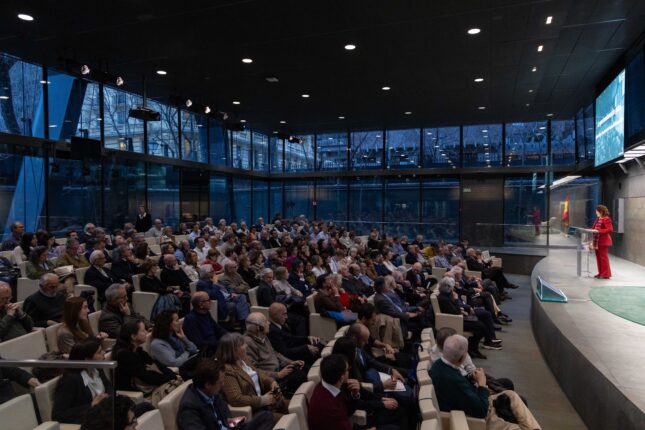
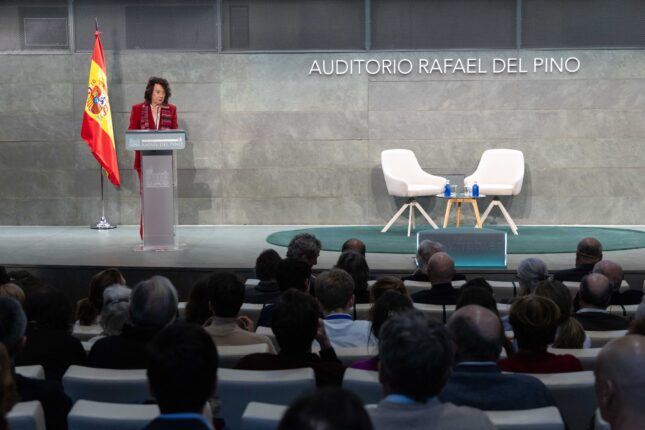
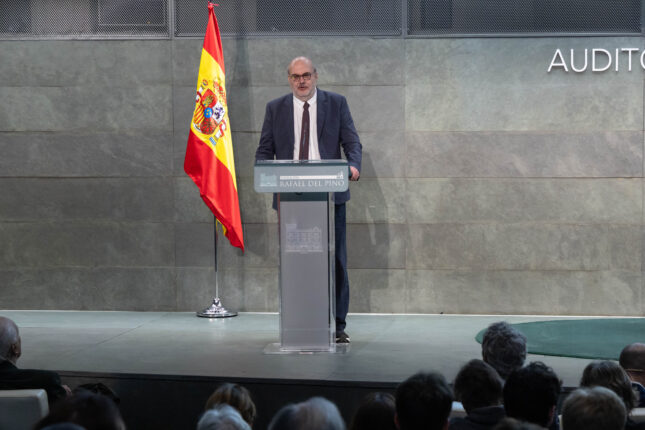
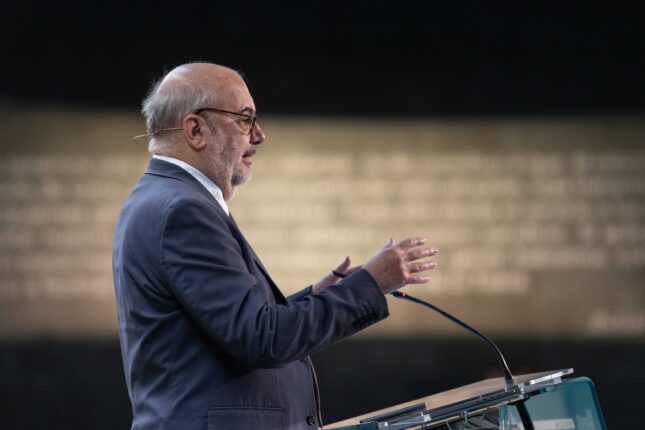
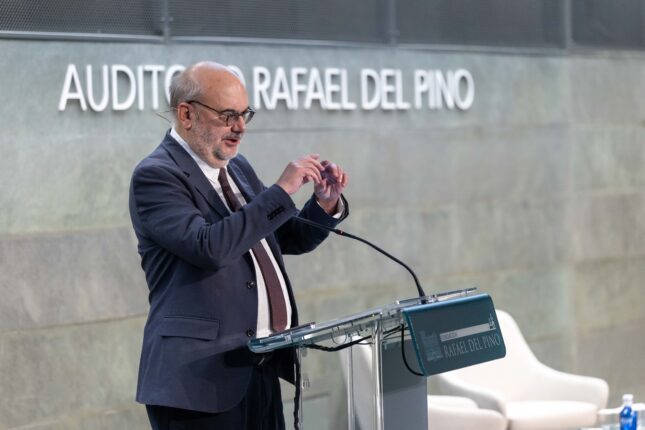
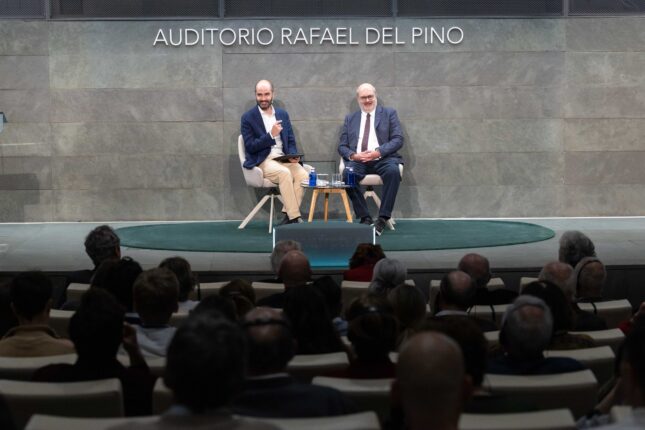
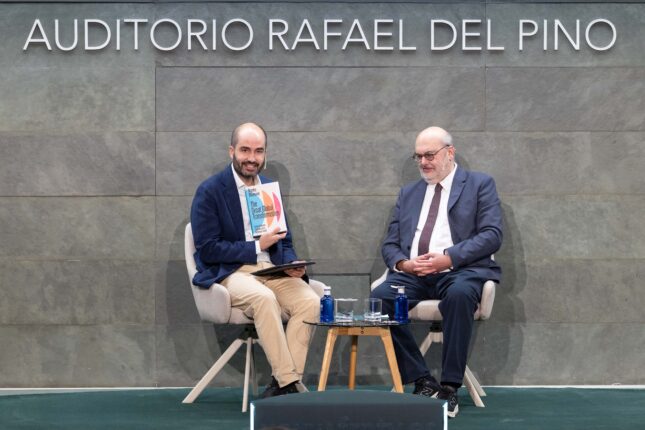
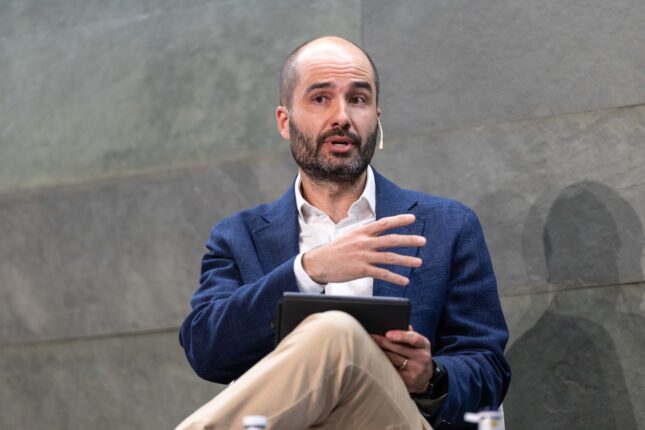
On 4 March 2026, the Rafael del Pino Foundation organised the Keynote Lecture «The Great Global Transformation», which was delivered by Branko Milanovic on the occasion of the presentation of his latest book of the same title. After the conference, he spoke with Miguel Almunia.
Branko Milanovic is a research professor at the Graduate Center of the City University of New York and senior academic affiliated with the Luxembourg Income Study. He also teaches at the London School of Economics and in the Institute of International Studies of Barcelona. In 2019, he was appointed Honorary Maddison Professor at the University of Barcelona. Groningen. The teacher Milanovic was Chief Economist at the World Bank and has been a visiting professor and researcher at the universities of Maryland, Johns Hopkins, Oxford and Carlos III of Madrid. He was Senior Associate of the Carnegie Endowment for Peace in Washington. D. from the University of Belgrade, he has had an extensive and prolific research career, including such works as: “The Haves and the Have-nots”selected by The Globalist as Book of the Year 2011; “Global Inequality”awarded with the Bruno Kreisky Prize for the best political book of the year 2016 and the Hans Matthöfer Prize in 2018, a work translated into 16 languages; “Capitalism, Alone”included in the list of Best Books of the magazine Foreign Affairs as one of the best reads of 2019 in global politics and economics; or his latest work “The Great Global Transformation”(2026), among others. He has received (together with Mariana Mazzucato) the Leontief Award 2018 by advancing the frontiers of economic knowledge. The journal Prospect included in 2020 Branko Milanovic among the “Top 50 Thinkers”of the year. He is undoubtedly one of the world's most influential economists in the study of inequality and the evolution of capitalism, with a career that combines academic rigour and a long-term historical perspective.
Miguel Almunia is the Director of the Economics Department and Professor at CUNEF University. Ramón y Cajal Researcher (2022-2027). D. from U. of California, Berkeley and Excellence Fellow of the Rfael del Pino Foundation. He has published in prestigious international journals such as American Economic Review, Journal of Economic Perspectives, AEJ: Economic Policy and Review of Economics and Statistics. Awarded the Julián Marías 2022 prize for researchers under 40 years of age. Principal Investigator (PI) in research projects funded by the BBVA Foundation (Leonardo grant), the Ramón Areces Foundation, the Ministry of Science (twice) and the International Growth Centre. Associate researcher at CEPR and member of the editorial boards of International Tax and Public Finance and SERIEs - Journal of the Spanish Economic Association. One six-year research period recognised.
Summary:
Economist Branko Milanovic presented his work at the Rafael del Pino Foundation. The great global transformation, a reflection on the profound changes that are reshaping the global economy. The conference, held on 4 March 2026, was followed by a dialogue with Miguel Almunia.
The global economy is undergoing a far-reaching transformation that is altering the distribution of wealth, power and influence between countries. This was the starting point of the keynote lecture given by economist Branko Milanovic -one of the world's leading experts on economic inequality- at the Rafael del Pino Foundation on the occasion of the presentation of his book The great global transformation.
The title of the work deliberately refers back to The great transformation by Karl Polanyi (1942). However, as Milanovic explained, the phenomenon we observe today has a different dimension: today's transformation is global, not limited to a particular economy. If Polanyi analysed the transformation of industrial capitalism in the United Kingdom, Milanovic argues that today we are witnessing a a process of economic rebalancing on a global scale.
The rise of Asia and global economic rebalancing
One of the most visible features of this transformation is the progressive shift of economic weight towards Asia. Over the last few decades, economies such as China, India and Indonesia have experienced sustained growth that has significantly modified the distribution of production and income in the world.
In aggregate terms, this process has involved gradual convergence between countriesMany economies that for decades were at much lower income levels have closed some of that gap with the advanced economies.
At the same time, this change has important structural consequences. As some emerging economies increase their economic weight, the relative share of Western countries in the world economy is tending to decline, The EU's economic growth has been slow, even if their income levels remain high in absolute terms.
Global inequality and the new global middle class
Another central element of Milanovic's analysis is the evolution of global inequality. Using global individual income data, the economist showed how, over the last few decades, inequality in the world's income distribution has been increasing, the overall income distribution has shifted to higher levels, The economic growth of the euro area, reflecting the general economic growth.
This process has led to the emergence of what some authors refer to as a “global middle class”, The EU, made up of hundreds of millions of people who have significantly improved their standard of living, especially in Asia.
However, Milanovic stressed that this phenomenon should be interpreted with caution. In many cases, the income levels of this new global middle class remain modest by the standards of advanced economies. Rather, it is a widening of the middle segment of the overall income distribution.
Economic convergence and geopolitical tensions
The process of economic convergence also has geopolitical implications. Milanovic noted that, historically, periods in which emerging powers move closer in economic capacity to established powers are often accompanied by strategic tensions.
From this perspective, the current relative rapprochement between China and the United States is one of the key elements in understanding the contemporary international context.
At this point, the economist recovered a reflection by Adam Smith that is particularly pertinent: economic convergence between countries tends to lead to convergence in technological and military capabilities, This can lead to a balance of power that influences international stability.
Transformations in economic elites
The conference also addressed changes in the composition of economic elites. In many advanced economies, Milanovic explained, we observe the emergence of a social group that combines high labour income with high capital income, This was less common in earlier stages of capitalism.
This phenomenon reflects the growing importance of sectors such as finance, technology or highly skilled professions, where individuals can simultaneously receive very high salaries and participate in the ownership of assets.
In the case of China, the analysis shows a different but equally significant evolution. Urban elites have become increasingly diversified, with a greater weight of private entrepreneurs and highly skilled professionals in the upper strata of the income distribution.
A world in transition
Overall, Milanovic described a scenario in which the world economy is in the midst of a transition process. Reduced inequality between countries, the rise of new economic powers and changes in the structure of elites are shaping a new global equilibrium.
This process poses significant opportunities, but also political and social challenges. As the economist pointed out, understanding these dynamics is essential to interpreting the changes taking place in the international economy and politics.
The conference concluded with a dialogue with Miguel Almunia in which the economic and geopolitical implications of this global transformation, as well as possible future scenarios for the international economic order, were explored in depth.
The Rafael del Pino Foundation is not responsible for the comments, opinions or statements made by the people who participate in its activities and which are expressed as a result of their inalienable right to freedom of expression and under their sole responsibility. The contents included in the summary of this conference are the result of the debates held at the meeting held for this purpose at the Foundation and are the responsibility of their authors.
The Rafael del Pino Foundation is not responsible for any comments, opinions or statements made by third parties. In this respect, the FRP is not obliged to monitor the views expressed by such third parties who participate in its activities and which are expressed as a result of their inalienable right to freedom of expression and under their own responsibility. The contents included in the summary of this conference are the result of the discussions that took place during the conference organised for this purpose at the Foundation and are the sole responsibility of its authors.