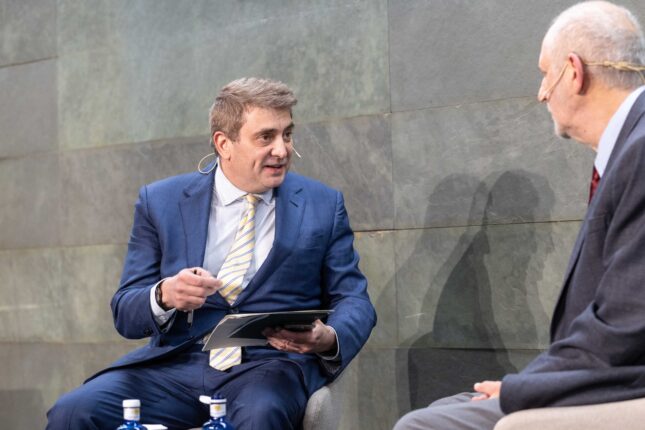
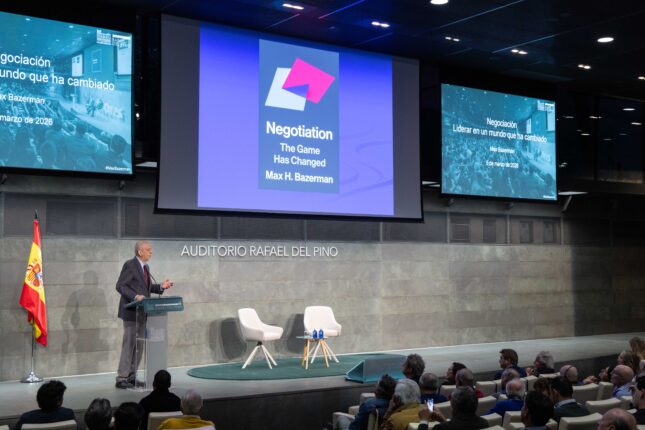
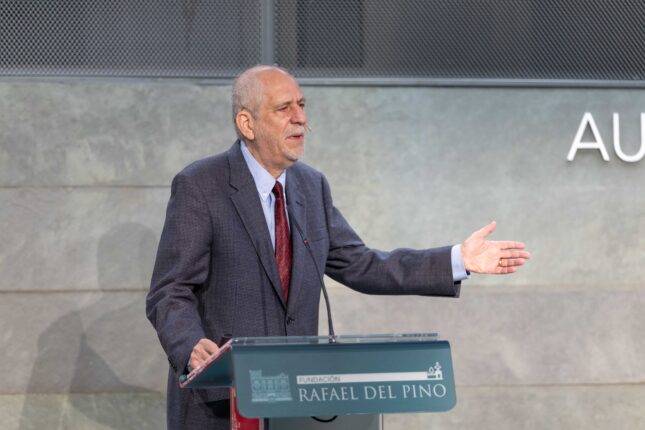
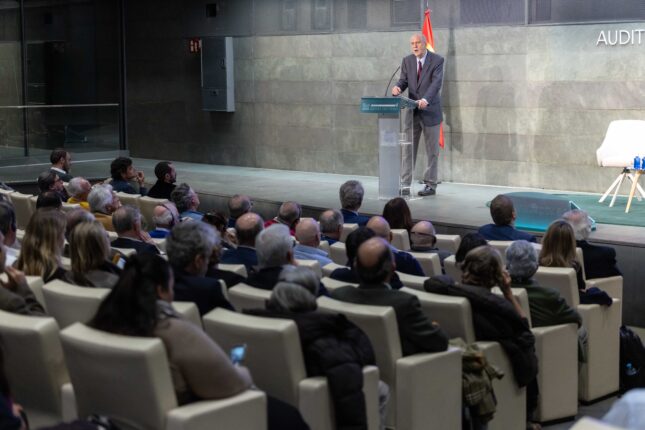
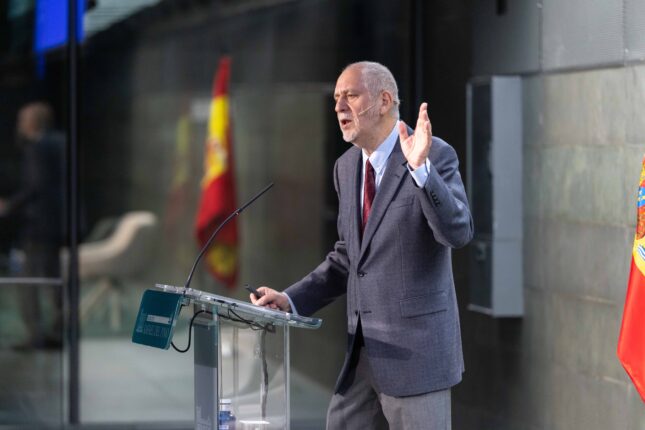
On 5 March 2026, the Rafael del Pino Foundation organised the Master Lecture «.«Negotiation: Leading in a world that has changed»will be given by Max Bazerman, Jesse Isidor Straus Professor of Business Administration in the Harvard Business School, on the occasion of the publication of his latest book «Negotiation: The Game Has Changed». After the conference, he spoke with Professor Enrique Peña.
Max H. Bazerman is one of the world's leading authorities on leadership, decision-making and business ethics. An honorary doctorate from the University of London, he has devoted his career to studying why even smart, well-intentioned people make predictable decision-making mistakes - and how to avoid them - helping leaders and organisations to think more clearly, anticipate risks and act with integrity. The author of key works on negotiation, bias and ethical “blind spots”, he combines world-class academic research with extensive experience advising major companies around the world. Recent books include Complicit; Decision Leadership (with Don A. Moore); Better, Not Perfect; The Power of Experiments (with Michael Luca); The Power of Noticing; Judgment in Managerial Decision Making (with Don A. Moore); and Blind Spots (with Ann Tenbrunsel). His profile unites intellectual rigour, practical impact and a deep commitment to more responsible and conscious management.
Enrique Peña is a civil engineer and professor specialising in negotiation and business strategy. He is deputy director of the Negotiation and Mediation Centre at IE Business School and associate professor at various IE schools, where he teaches undergraduate, postgraduate and executive programmes. He has more than twenty years of experience in business development and strategic management in sectors such as infrastructure, energy and telecommunications, having worked in companies such as Shell, BCG, Orange and Renfe. He holds an MBA from The Wharton School and is a Rafael del Pino Foundation Excellence Fellow. He currently combines his academic activity with independent consultancy in business and technology strategy.
The
Summary:
The Rafael del Pino Foundation held, last year 5 March 2026, the keynote lecture «Negotiation: Leading in a changed world».»The event will be given by Max Bazerman, Jesse Isidor Straus Professor of Business Administration of the Harvard Business School, on the occasion of the publication of his latest book, «Negotiation: The game has changed».». Following his presentation, Professor Bazerman held a dialogue with Professor Enrique Peña.
Negotiation in a context of global transformation
During his lecture, Bazerman analysed how the profound political, economic, social and technological transformations of the last decades have significantly changed the context in which negotiation processes take place today. Among the factors that have altered this environment, he highlighted the growing social polarisation, changes in the geopolitical balance, the expansion of the digital economy and the impact of artificial intelligence.
In his view, these changes force leaders and managers to rethink the way they approach negotiations. Understanding the context in which negotiations take place is more important than ever to adapt strategies appropriately and reach effective agreements.
The validity of the fundamental principles of negotiation
Despite these changes, Bazerman stressed that the fundamental principles of negotiation remain fully valid. In particular, he underlined the importance of knowing the best alternative to a negotiated settlement (BATNA), understanding the interests of the other party, identifying the possible area of agreement and explore opportunities for value creation.
He explained that these concepts remain essential tools for improving the quality of decisions and achieving mutually beneficial agreements, although they must be applied taking into account the particularities of each context.
Negotiation strategy and decision-making
The Harvard professor also addressed some common debates surrounding negotiation strategies. Among them, he analysed the practice of making extremely high initial offers as an anchoring mechanism and questioned the advisability of applying this strategy systematically, as it can generate mistrust or even prevent the negotiation from taking place.
He also reflected on the idea, popularised in some negotiation approaches, of always avoiding splitting the difference between the parties. In his view, such rules of thumb should be interpreted with caution, as in certain circumstances an equitable split may be a reasonable and efficient solution.
The ethical dimension of negotiation
Bazerman also devoted part of his presentation to the ethical dimension of negotiation. He pointed out that many behaviours that may be perceived as unfair or unethical do not necessarily stem from a deliberate intention to harm others, but rather from cognitive biases or self-interested perceptions of reality.
In this regard, he stressed the importance for negotiators to be aware of these biases, both their own and those of others, in order to avoid distorted decisions and to promote more accountable and transparent practices.
Changing the rules of the game
Finally, Bazerman explained that in certain situations, it is not enough to negotiate better, but it may be necessary to modify the negotiation process itself. Using different examples, he illustrated how altering the rules of the game can help to unblock complex negotiations, reduce extreme positions and favour more balanced agreements.
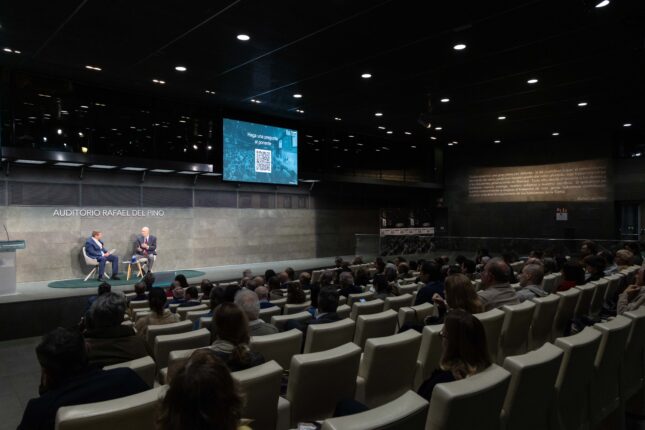
After the lecture, Professor Enrique Peña discussed with the speaker the main challenges of negotiation in the current context, characterised by uncertainty, technological acceleration and changes in the international balance. The event concluded with a colloquium in which the participants took part.
The Rafael del Pino Foundation is not responsible for the comments, opinions or statements made by the people who participate in its activities and which are expressed as a result of their inalienable right to freedom of expression and under their sole responsibility. The contents included in the summary of this conference are the result of the debates held at the meeting held for this purpose at the Foundation and are the responsibility of their authors.
The Rafael del Pino Foundation is not responsible for any comments, opinions or statements made by third parties. In this respect, the FRP is not obliged to monitor the views expressed by such third parties who participate in its activities and which are expressed as a result of their inalienable right to freedom of expression and under their own responsibility. The contents included in the summary of this conference are the result of the discussions that took place during the conference organised for this purpose at the Foundation and are the sole responsibility of its authors.