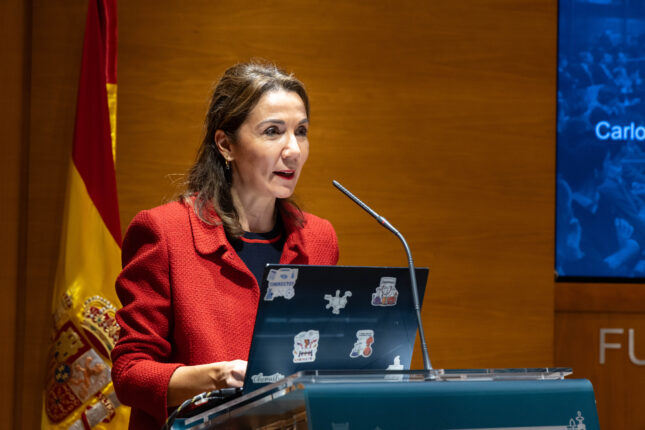
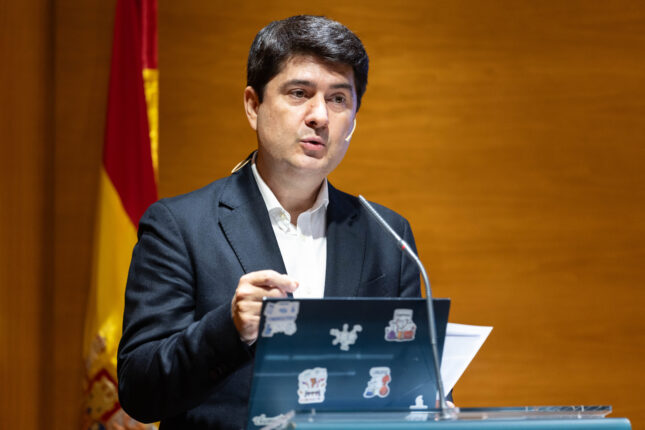
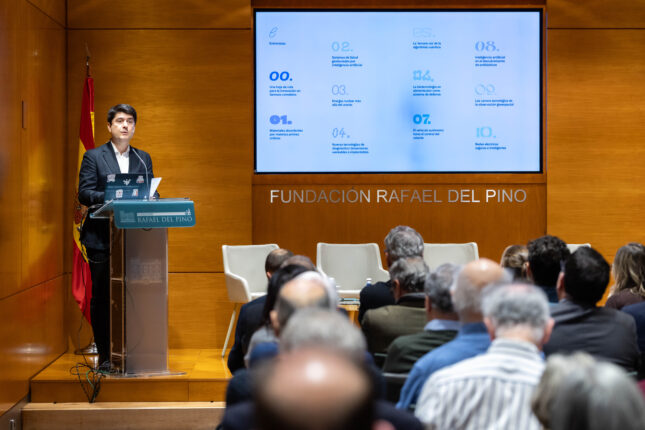
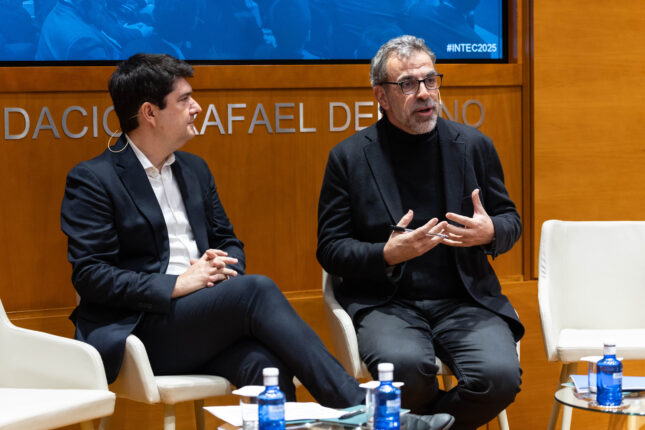
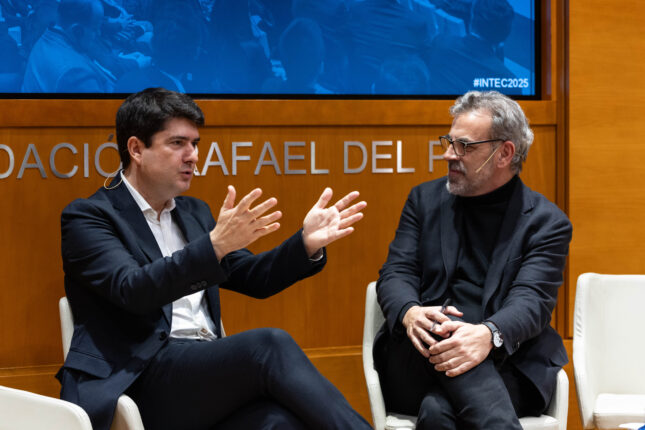
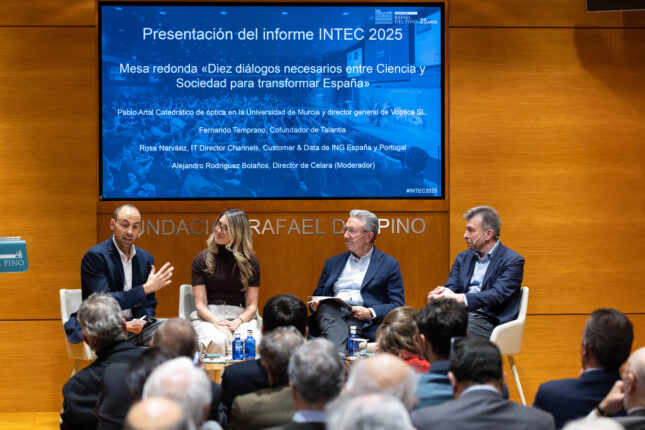
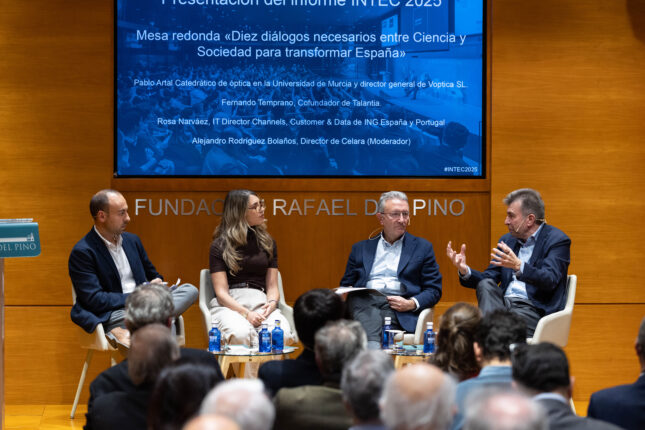
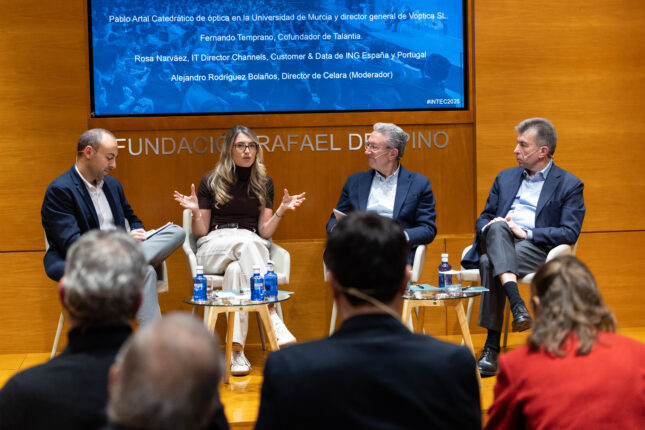
Javier García, Miguel Hoyos, María José Alonso, Pablo Artal and Fernando Temprano.
The Rafael del Pino Foundation organised, on 24 November 2025, the presentation of the conclusions of the INTEC 2025 report of its Chair in Science and Society, entitled «Presentation of the report INTEC 2025. A roadmap for innovation in complex times».» in which the following participated Javier García, Miguel Hoyos, Andrés Pedreño, Pablo Artal and Fernando Temprano.
The event took place according to the following programme:
19:00h Welcome
Dialogue «Ten technologies to boost Spain» in which the following will take part Javier García, Director of the Rafael del Pino Chair in Science and Society and Miguel Ángel Hoyos, journalist at RTVE. Co-director of «Culturas2», director of «Un país para leerlo».
19:30h Round table «Ten necessary dialogues between Science and Society to transform Spain».»
Pablo Artal Professor of Optics at the University of Murcia and Managing Director of Voptica SL.
Fernando Temprano, Co-founder of Talantia.
Rosa Narvaez, IT Director Channels, Customer & Data, ING Spain and Portugal
Alejandro Rodríguez Bolaños, Director of Celera (Moderator)
Summary:
On 24 November 2025, the Rafael del Pino Foundation held the presentation of the INTEC 2025 Report, The Rafael del Pino Science and Society Chair. Under the heading «A roadmap for innovation in complex times».», The report offers an in-depth and rigorous look at the scientific, technological and social challenges Spain is facing in an international context marked by uncertainty.
The welcome to the event underlined a message that sums up well the philosophy of the Foundation: science, innovation and technology transfer are not abstract concepts, but real levers to strengthen the country's economic, social and institutional progress. At a time of unprecedented technological acceleration, but also of polarisation, misinformation and crisis of confidence, the Foundation vindicates the need to build a common vision in which science, business and society converge.
A diagnosis to understand the present and project the future
In his intervention, Javier García, The Director of the Chair, National Research Award 2024 and King Jaime I Award for New Technologies, placed the conclusions of the report in the context of a world undergoing simultaneous tensions. On the one hand, we are experiencing a technological revolution that is transforming the way in which we produce, relate to each other and learn; on the other, we are witnessing the weakening of institutions, the reconfiguration of borders, the resurgence of conflicts and the widening of the gap between the speed of technological change and the response capacity of public and regulatory systems.
Spain, he pointed out, is no stranger to these dynamics. The country is dragging structural problems -persistently low productivity, a dual labour market, high indebtedness and a growth model that does not incorporate sufficient added value - all of which condition their ability to compete at the technological frontier. Added to this is the urgent need to update a regulatory framework that, on many occasions, does not keep up with the speed of change.
However, the report does not stop at the diagnosis, but uses it as a basis for imagining possibilities and charting paths. INTEC 2025 identifies ten technologies with transformative potential for the Spanish economy, selected after an exhaustive analysis of their scientific soundness, industrial viability, social impact and capacity to strengthen the productive fabric. These are not fads, García stressed, but concrete solutions to real challenges.
Ten technologies for a country that wants to lead
In his dialogue with Miguel Angel Hoyos, RTVE journalist, Javier García, spoke in depth about these technologies, which range from the new materials and the reduction of dependence on critical raw materials through to the promotion of a Health 5.0 able to free up professionals' time and orient the system towards prevention. He also addressed the vital importance of smart grids able to sustain the digitalisation and electrification of the economy; the possibilities of the thorium and molten salt reactors; and the growing prominence of the quantum algorithm, which will mark a new frontier in advanced computing.
The conversation highlighted another of the report's central messages: artificial intelligence cuts across all areas, but it is not enough to celebrate or fear it. It is necessary to understand your risks, The technology is not neutral: it needs to be oriented, he said. Technology, García recalled, is not neutral: it needs to be guided. “The more technological our society is, the more humanistic our education must be”.”, He said, recalling that innovation only makes sense when it puts people at the centre.
Science, business and society: an essential triangle
Reflection continued at the round table «Ten necessary dialogues between Science and Society to transform Spain».», moderated by Alejandro Rodríguez Bolaños, director of Celera. The participants were Pablo Artal, Professor and technology entrepreneur; Fernando Temprano, energy transition expert; and Rosa Narvaez, Director of Technology and Data at ING Spain and Portugal.
Each, from their own field, illustrated the complexity - but also the necessity - of building real bridges between the generation of knowledge and its application in the world. Artal described the difficulties researchers face when trying to bring disruptive innovations to market in sectors as regulated as health. Temprano analysed the strategic challenges of the energy transition, underlining the importance of regulatory stability and technical focus in far-reaching decisions. Narváez, for his part, highlighted the need to manage technological change from a deep understanding of human needs, without falling into an uncritical fascination with the tool.
Overall, the table left a clear message: Spain has the necessary talent, scientific capabilities and entrepreneurial drive., But it needs to consolidate an environment that allows it to transform this potential into competitiveness, productivity and well-being.
An invitation to act
The INTEC 2025 Report does not pretend to offer closed predictions or magic solutions. It is, above all, a invitation to action. A call to articulate a shared project that takes advantage of the opportunities of this decisive decade and makes innovation the backbone of the country.
As Javier García recalled at the end of his speech, «the future is written where science, society and business meet».». At a time of global challenges, Spain has a window of opportunity to reinforce its strategic autonomy, modernise its economy and build an inclusive model of prosperity.
Seizing that opportunity requires courage, long-term vision and a willingness to work together. But above all, it requires something profoundly human: the ability to imagine a better future and to decide to build it together.
The Rafael del Pino Foundation is not responsible for the comments, opinions or statements made by the people who participate in its activities and which are expressed as a result of their inalienable right to freedom of expression and under their sole responsibility. The contents included in the summary of this conference are the result of the debates held at the meeting held for this purpose at the Foundation and are the responsibility of their authors.
The Rafael del Pino Foundation is not responsible for any comments, opinions or statements made by third parties. In this respect, the FRP is not obliged to monitor the views expressed by such third parties who participate in its activities and which are expressed as a result of their inalienable right to freedom of expression and under their own responsibility. The contents included in the summary of this conference are the result of the discussions that took place during the conference organised for this purpose at the Foundation and are the sole responsibility of its authors.