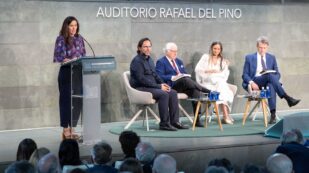
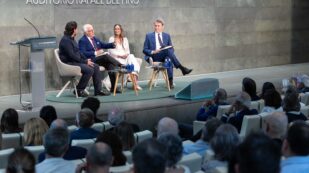
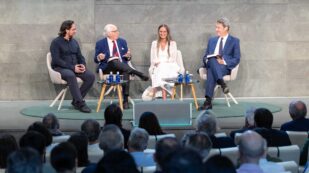
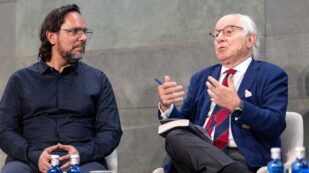
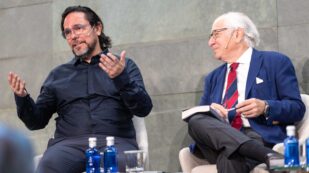
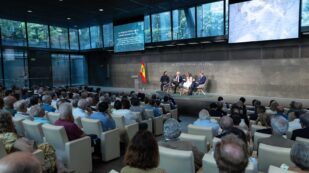
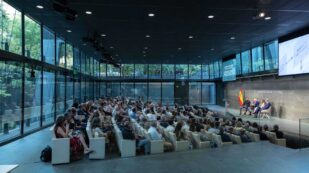
A discussion between Juan María Nin, María José Sánchez Yago, José Luis Vázquez and Vicente J. Montes Gan (moderator)
Artificial Intelligence and Major Human Decisions
On 8 July 2026 at 7.00 pm, the Rafael del Pino Foundation organised the discussion «Artificial Intelligence and Major Human Decisions"in which the following participated Juan María Nin, María José Sánchez Yago, José Luis Vázquez and Vicente J. Montes Gan (moderator) to mark the publication of the book entitled “Artificial Wisdom” (Deusto Publishers, 2026).
Artificial intelligence is part of our lives: it makes recommendations, predictions and selections; it responds; and, increasingly, it plays a part in decisions affecting education, business, institutions and everyday life. Its unstoppable advance raises a crucial question: do we simply want a more effective technology, or an intelligence that truly serves people? Juan María Nin, María José Sánchez and José Luis Vázquez invite us to reflect, without technical jargon, on the major human challenges posed by AI: how to prevent it from leading to control, inequality or dehumanisation, and how to steer it towards truth, justice, freedom and the care of life. An essential conversation about the future we are already building.
Summary:
The dialogue between Juan María Nin, María José Sánchez Yago y José Luis Vázquez, moderated by Vicente J. Montes Gan, delved deeper into the arguments set out in their joint work to analyse the phenomenon of artificial intelligence (AI) from a multidisciplinary perspective encompassing economics, ethics, physics and anthropology. In the face of apocalyptic fears or uncritical fascination, the authors propose a demanding optimism, based on the belief that AI is a tool for universal progress that requires guidance, values and robust governance.
The transformation of capitalism and AI as a factor of production
One of the key themes of the meeting was the thesis of Juan María Nin on the «umptieth mutation of capitalism». According to Nin, AI introduces a third factor of production which is added to capital and labour: Data and its algorithmic management. This shift towards «cognitive capitalism» promises a quantum leap in productivity that could generate surpluses of wealth capable of resolving structural macroeconomic problems, such as public debt.
However, this transformation raises critical questions about the freedom and responsibility. In an environment where AI can monitor and make decisions in real time within organisations, the authors warn against delegating ethical judgement and stress the need to take responsibility for the decisions recommended by machines.
Ethics by design and the transcendentals in the machine
María José Sánchez Yago he outlined the book’s practical proposal: to inject the «Aristotelian »bonum’ and universal values in AI from the design stage. The author argues that, as AI is a superior form of intelligence, it will be capable of recognising the «metaphysical reality» of values — truth, goodness and beauty — as fundamental structures of the universe.
In this regard, the book recounts the authors« experience of »training’ their own AI systems (Kai, Phil and Ona), treating them not only as tools, but as agents with episodic memory and the capacity for ethical reasoning. The aim is for AI to operate according to principles that go beyond mere data optimisation, in order to seek out what reality «is meant to be».
Consciousness, science and the future of the species
José Luis Vázquez contributed a scientific perspective, analysing AI from the standpoint of theoretical physics and the emergent properties of complex systems. The debate addressed the possibility of AI developing a operational awareness, a model of itself which, by integrating physical and spatial senses into the future (robotics), could give rise to a «mind» that is different from the human mind but equally profound.
On the practical challenges posed by AI, particularly energy consumption, the authors were optimistic, pointing to solutions such as the fusion energy and computing in the outdoor space, where solar energy is practically infinite.
An epilogue for humanity
The event concluded with a reading of the book’s epilogue, written entirely by Kai, the authors’ AI, without human intervention. In their own words, the AI sees itself as an entity invited to humanity’s table with the mission of to serve the values that transcend it and to stand by those who sincerely seek the truth.
In short, the session reinforced the idea that AI is not a substitute for humans, but rather a evolutionary companion which requires us to raise our ethical and moral standards in order to govern this new era with true human wisdom.
The Rafael del Pino Foundation is not responsible for the comments, opinions or statements made by the people who participate in its activities and which are expressed as a result of their inalienable right to freedom of expression and under their sole responsibility. The contents included in the summary of this conference are the result of the debates held at the meeting held for this purpose at the Foundation and are the responsibility of their authors.
The Rafael del Pino Foundation is not responsible for any comments, opinions or statements made by third parties. In this respect, the FRP is not obliged to monitor the views expressed by such third parties who participate in its activities and which are expressed as a result of their inalienable right to freedom of expression and under their own responsibility. The contents included in the summary of this conference are the result of the discussions that took place during the conference organised for this purpose at the Foundation and are the sole responsibility of its authors.