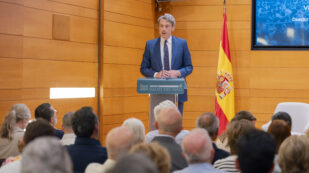
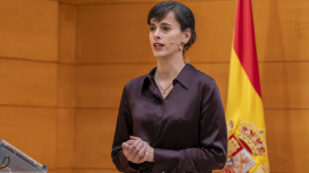
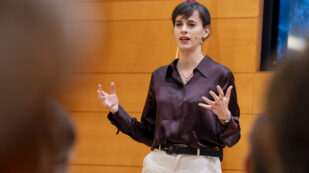
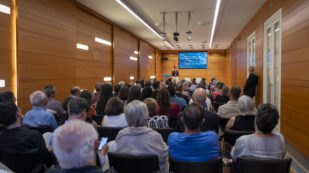
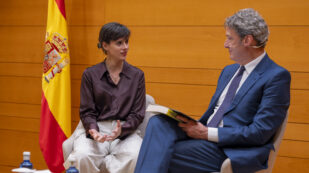
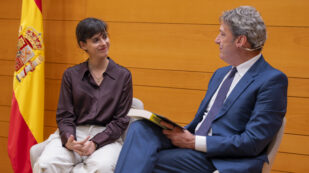
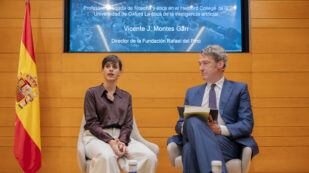
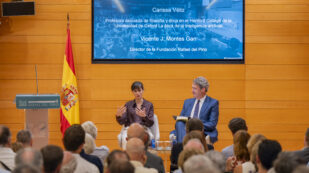
Dialogue between Carissa Véliz and Vicente J. Montes Gan
Privacy, prophecy and power: from ancient oracles to algorithms
On 17 June, the Rafael del Pino Foundation organised a discussion entitled «Privacy, prophecy and power: from ancient oracles to algorithms» in which the following participated Carissa Véliz y Vicente J. Montes Gan to mark the publication of his latest book, *Prophecy: Lessons on the Use and Abuse of Prediction, from Ancient Oracles to AI*, published by Debate
Carissa Véliz is a lecturer at the Institute for Ethics in Artificial Intelligence and a Fellow of Hertford College at the University of Oxford. She is the recipient of the prestigious Herbert A. Simon 2021 award for outstanding research in computer science and philosophy. His academic work has been published by Nature, Harvard Business Review, and AI & Society, among others. She has published for the Guardian, Wired, and El País. She is the author of the acclaimed book «Privacy is Power: Data, Surveillance and Freedom in the Digital Age» (Debate) and editor of the Oxford Handbook of Digital Ethics. She advises policy makers around the world on privacy and the ethics of artificial intelligence. In Spain, she has been a member of the expert group that advised the Ministry of Economic Affairs and Digital Transformation on the Charter of Digital Rights; she also advised the Ministry of Foreign Affairs on the country's Digital Strategy.
Vicente J. Montes Gan, holds a degree in Economics and Business Administration from the UAM and a PhD from the Faculty of Law of the UCM. He is a member of the Cuerpo Superior de Técnicos Comerciales y Economistas del Estado and of the European Academy of Sciences and Arts of Salzburg. Officer of the Order of Isabel La Católica, Leão de Oro de la República de Angola (AIA), I Premio de Ensayo Casa África and Medalla al mérito de la Guardia Civil con distintivo blanco. He is Director of the Rafael del Pino Foundation, Vice-President of the Spanish Association of Foundations, Patron of the NGO AMREF Salud Africa, Founder and President of Liberdom and member of the Editorial Board of ICE. His previous professional activities include: Vice-President of the Spanish Network of the United Nations Global Compact; President of the Association of TCEE; Chief Economic and Commercial Counsellor at the Spanish Embassies in Angola, Namibia, Congo, D.R. Congo, Sao Tome and Principe and Zambia; Director of Division of ICEX; and Deputy Director General of the Court for the Defence of Competition. He has been Professor of Economic Analysis at the Carlos III University of Madrid and President of the Economic Sciences Section of the Ateneo de Madrid.
Summary:
On 17 June, the Rafael del Pino Foundation hosted the dialogue «Privacy, prophecy and power: from ancient oracles to algorithms», in which the philosopher took part Carissa Véliz, associate professor at the Institute for the Ethics of Artificial Intelligence at the University of Oxford, and Vicente J. Montes Gan, Director of the Rafael del Pino Foundation, on the occasion of the publication of Prophecy. Lessons on the use and abuse of prediction, from ancient oracles to AI. (Debate).
Privacy as a prerequisite for freedom
During the conversation, Véliz argued that privacy is neither a luxury nor a secondary individual concern, but rather an essential prerequisite for personal freedom, civic autonomy and the proper functioning of democracies. As he explained, the mass accumulation of personal data grants unprecedented power to those who control it, enabling them to anticipate and, on occasions, influence the behaviour of individuals.
Prediction as a new form of power
One of the main themes of the meeting was a reflection on prediction as a new form of power. The author argued that the current digital economy is underpinned by a logic of surveillance whose aim is not merely to understand people, but to predict their future decisions. In this regard, she warned of the risk that algorithms might not merely describe the future, but actively contribute to shaping it, turning probabilities into destinies and creating self-fulfilling prophecies.
Véliz emphasised that many decisions affecting citizens’ lives — such as the granting of loans, access to certain jobs or risk assessment — are increasingly based on algorithmic predictions. In his view, this raises significant ethical issues, as predictions are not verifiable facts and can hinder accountability, limit individual opportunities and reinforce dynamics of exclusion that are difficult to challenge.
Social media, democracy and the public sphere
The discussion also addressed the impact of social media and digital platforms on the quality of democratic life. Véliz argued that these tools were not designed to strengthen public deliberation or civic coexistence, but rather to maximise attention-grabbing and data collection. This business model, he stated, encourages polarisation, the dissemination of emotionally charged content and the fragmentation of the public sphere, thereby undermining the shared narratives that enable social cooperation and trust amongst citizens.
The impact on young people and the culture of care
The philosopher also expressed concern about the effects of these technologies on young people. In her view, constant surveillance, perpetual exposure to social comparison and dependence on external validation are contributing to increased anxiety and a loss of autonomy. In response to this, she emphasised the importance of privacy as a necessary space for personal development and defended the value of reading and books as key tools for cultivating attention, critical thinking and an understanding of other people’s experiences.
Artificial intelligence and ethical responsibility
With regard to artificial intelligence, Véliz drew a distinction between applications designed to understand physical or natural phenomena — such as biomedical research or the discovery of new materials — and those aimed at classifying, monitoring or predicting human behaviour. Whilst the former can be integrated into rigorous scientific processes, he warned that the latter require particular ethical caution due to their capacity to influence people’s decisions and opportunities.
Technology, democracy and human rights
Another highlight of the meeting was the discussion on the relationship between technology, democracy and human rights. In the face of the tendency to present technological development as an inevitable process, Véliz argued for the need to strengthen mechanisms of democratic control, ensure transparency in automated decision-making and protect citizens’ autonomy. In his view, the fundamental question is whether new technologies expand people’s ability to lead their own lives or, on the contrary, reduce their scope for decision-making and transfer power to increasingly opaque public and private actors.
Uncertainty as a space of freedom
In conclusion, the author called for a critical yet hopeful vision of the future. She pointed out that uncertainty is an essential condition of human freedom and argued that the impossibility of fully knowing the future opens up scope for creativity, responsibility and collective action. In this regard, she argued that privacy and predictability have become two central issues for understanding the challenges of our time and for preserving freedom, democracy and human rights in the digital age.
The Rafael del Pino Foundation is not responsible for the comments, opinions or statements made by the people who participate in its activities and which are expressed as a result of their inalienable right to freedom of expression and under their sole responsibility. The contents included in the summary of this conference are the result of the debates held at the meeting held for this purpose at the Foundation and are the responsibility of their authors.
The Rafael del Pino Foundation is not responsible for any comments, opinions or statements made by third parties. In this respect, the FRP is not obliged to monitor the views expressed by such third parties who participate in its activities and which are expressed as a result of their inalienable right to freedom of expression and under their own responsibility. The contents included in the summary of this conference are the result of the discussions that took place during the conference organised for this purpose at the Foundation and are the sole responsibility of its authors.