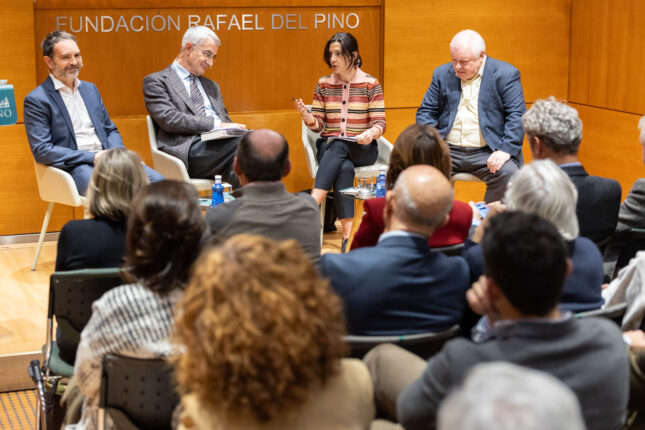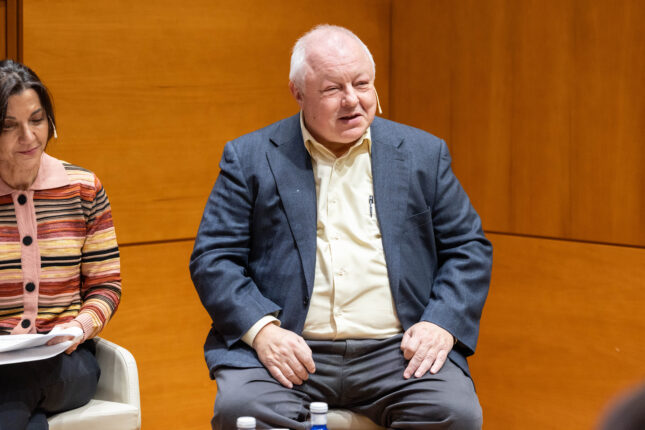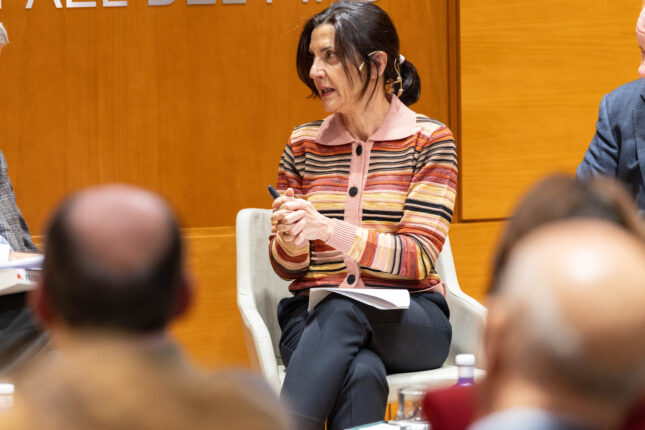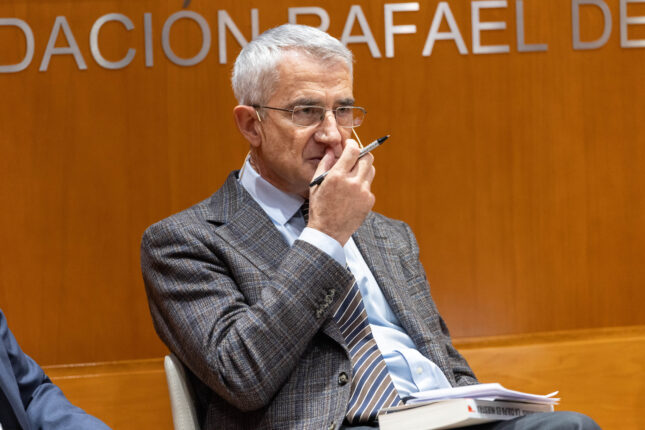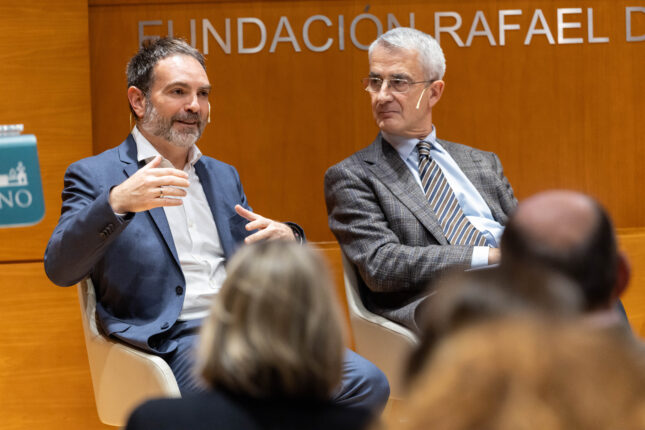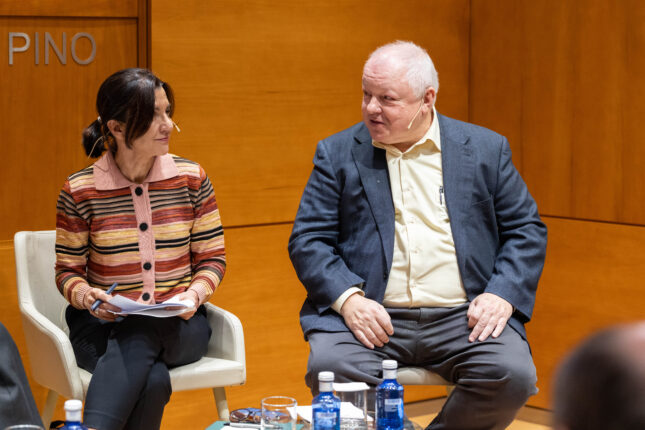


Dialogue between Ángel de la Fuente, Luis Miller, Benito Arruñada and Maite Rico

Is it our fault? How citizens' preferences hold back reforms in Spain

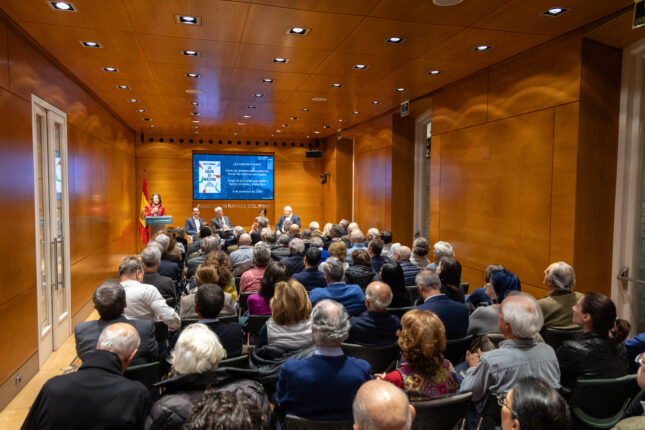
On 4 December 2025, the Rafael del Pino Foundation organised a discussion entitled «Is it our fault? How public preferences are holding back reforms in Spain», with the participation of Ángel de la Fuente, Luis Miller, Benito Arruñada and Maite Rico.

Angel de la Fuente is Executive Director of the Foundation for Applied Economic Studies (FEDEA). He holds a PhD in Economics from the University of Pennsylvania, where he received the prize for the best doctoral thesis in 1991, and an MBA from Drexel University. After his return to Spain he joined the Institute of Economic Analysis of the CSIC, where he is a Senior Scientist on leave of absence and has been vice-director of the centre and member of the Commission of the Humanities and Social Sciences Area of the organisation. He is a research fellow at the CESIfo Institute in Munich and a member of the Barcelona School of Economics (BSE) and has taught postgraduate courses at the Autonomous University of Barcelona and other Spanish universities. He has been executive editor of Journal of Applied Economics and senior member of the European Expert Network on the Economics of Education. De la Fuente has worked as a consultant for the World Bank, the OECD, the European Commission and various Spanish administrations. In 2002 he was runner-up in the 1st Banco Herrero Foundation Prize for young researchers in the social sciences.

Luis Miller is a senior scientist at the Instituto de Políticas y Bienes Públicos of the CSIC. He obtained his PhD in Sociology from the Complutense University and the IESA-CSIC, where he held a pre-doctoral research fellowship. He then worked as a postdoctoral researcher at the Max Planck Institute for Economics (Jena) and at the Centre for Experimental Social Science at Nuffield College, University of Oxford, where he also served as deputy director. In 2011 he joined the Faculty of Economics and Business at the University of the Basque Country as a permanent lecturer in microeconomics and experimental and behavioural economics. He has carried out research stays at leading institutions in six countries and three continents, including the University of Essex (UK), Indiana University (USA), the Federal Institute of Technology in Zurich (Switzerland), Monash University (Australia) and the Carlos III University of Madrid. His main line of research focuses on the theoretical and experimental study of the norms of equity and distributive justice. In the last decade he has analysed the relationship between socio-economic status and recognition of merit and effort, and more recently he has worked on multilateral bargaining, as well as on identity, political polarisation and trust.

Benito Arruñada is Professor of Business Organisation at Pompeu Fabra University, Barcelona. Affiliated Professor of the Barcelona School of Economics and Research Associate at the Foundation for Applied Economic Studies (Fedea). Previously, after graduating from the universities of Oviedo and Rochester, he was Full Professor and Professor at the Universities of Oviedo and León, and John M. Olin Visiting Scholar in Law and Economics at Harvard Law School. He has occasionally taught at other universities, including Paris I, Sorbonne, Paris X, Nanterre, Singapore Management University, Frankfurt, UAM and Pablo Olavide.

Maite RicoColumnist for EL MUNDO, she has been deputy editor and founder of LA LECTURA, the newspaper's cultural magazine. She is also an analyst at Onda Cero and EsRadio. Until 2018 she was at EL PAÍS, where she was deputy editor after developing her career in the International and Opinion sections. She was a war reporter in Bosnia, Somalia and Libya, Latin America correspondent and editorialist. He then directed El País Weekly and launched the supplement Ideas. She is co-author, with Bertrand de la Grange, of the books Marcos, the brilliant imposture (Aguilar, Mexico and Madrid, 1998; and Plon, Paris, 1998), on the Zapatista uprising in the Mexican state of Chiapas, and Who killed the bishop? Autopsy of a political crime (Planeta, Mexico, 2003, and Martínez Roca, Madrid, 2005), on the assassination of the Guatemalan bishop Juan Gerardi.

Summary:

On 4 December 2025, the Rafael del Pino Foundation hosted a discussion entitled «Is it our fault? How public preferences are holding back reforms in Spain», to mark the publication of the book of the same name by Benito Arruñada (La Esfera de los Libros). He was joined in the debate by Ángel de la Fuente, Luis Miller and journalist Maite Rico, who moderated the conversation.

Beyond the presentation of a work, the session became an uncomfortable reflection on a diagnosis: Spain has been identifying the same economic and institutional problems for decades, but is unable to translate them into stable reforms. And, according to Arruñada, the explanation lies not only with political elites or interest groups, but also with the preferences of citizens themselves.

Preferences that push towards interventionism

Based on surveys comparing Spain with other European countries, Arruñada highlighted three characteristics that, in his opinion, set Spain apart:

  • Greater stagnation: a stronger preference for the state to be the primary guarantor of welfare.

  • Presenteeism: a tendency to prioritise the present over the future, evident in a long history of deficits and high public debt.

  • Aversion to competition: discomfort with unequal outcomes, which ultimately translates into fiscal and regulatory designs that penalise those who strive or take action.

According to the author, these preferences are reflected in specific policies. He gave several examples:

  • One Highly progressive income tax at low income levels, which reflects more concern that “the neighbour should not do too well” than maximising growth.

  • One reduced VAT in sectors such as hospitality and, at the same time, a high property transfer tax, which discourages mobility and penalises those who buy, invest or travel.

  • In housing, laws that protect the debtor or tenant at the expense of the creditor or landlord, prompting many investors to withdraw from the rental market.

  • In education, a system that, according to Arruñada, tends to punish effort and excellence, favouring a “levelling down”.

Taken together, it paints a picture: a society that distrusts competition and prefers redistribution to increased production.

Citizen determinism or room for leadership?

Ángel de la Fuente agreed that the economic and institutional results are unsatisfactory, but questioned Arruñada's “fatalistic” interpretation. In his opinion, not everything is predetermined by opinion polls: the functioning of the political system, the quality of leadership and institutional design introduce significant margins.

De la Fuente emphasised that many citizens remain moderate and favour “common sense”, while the system generates a more polarised political offering than actual demand. In his view, there are “transmission failures” between citizen preferences and effective policies, linked to party structure, coalition dynamics and the way stable majorities are formed.

Luis Miller, for his part, placed the problem somewhere in between: he agreed with much of the underlying diagnosis, but added that in recent decades ideological frameworks have emerged that legitimise these preferences. The focus has shifted from equal opportunities to equal outcomes, fuelling the demand for highly interventionist redistributive policies. At the same time, he pointed to the deterioration of intermediary institutions (weaker parties, less stability, short-term incentives), which make it difficult to pass complex reforms, even when there is social support.

Mediterranean social democracy and barriers to reform

One of the central themes was the crisis of the social democratic model. Arruñada distinguished between Nordic social democracy and a “Mediterranean social democracy,” which he characterised by:

  • Promising high levels of social protection,

  • Systematically concealing the real costs from the public,

  • And resting on fragile fiscal and demographic foundations.

He recalled that countries such as Denmark finance their welfare states with high general VAT rates and transparent tax structures, while Spain combines reduced rates, eroded bases and figures such as social security contributions, the real cost of which workers rarely see in their wages. The result is a model that is politically attractive in the short term but difficult to sustain in the medium and long term.

In this context, the real capacity of reforms “from above” was discussed. Arruñada cited the case of the liberalising reforms of the 1980s in Spain, many of which — especially the successful ones — were partially reversed when they clashed with dominant cultural preferences. Contrary to the myth of the “enlightened despot”, he argued that if reforms do not fit in with the cultural humus and expectations of the average voter, they tend to be short-lived.

Institutions, incentives and the marketplace of ideas

The debate also turned to institutional design. Miller defended the need to tackle political architecture reforms: improving the formation of governments, strengthening budgetary stability, reducing fragmentation and rethinking representation. Without changes to these rules of the game, he warned, Spain runs the risk of being unable to pass even moderate reforms, even if they are widely supported.

Arruñada, on the other hand, was sceptical about the effectiveness of certain “institutional solutions” when there is no clear social demand for change. He emphasised the crucial role of economic information and transparency: citizens need to see what they are paying for, what they are receiving and the returns on their decisions (for example, in terms of employment according to university studies or the quality of educational centres). The lack of public data—or its deliberate concealment—weakens the “marketplace of ideas” and encourages the perpetuation of economic myths.

Finally, the role of the media was criticised. Miller pointed out that polarisation has become a cheap business model for increasing audiences, while Arruñada recalled that, in a highly statist society, the existence of a powerful network of public media and institutional advertising is accepted as normal, with the consequent risk of capturing the debate.

The dialogue left a conclusion that was as uncomfortable as it was thought-provoking from an economic point of view: reforms do not fail solely because of a lack of political will or because of obstruction by interest groups; they fail because, to a large extent, they are consistent with what citizens prefer — or believe they prefer — given their perceptions of justice, effort and risk.

The big question that remains is whether Spain will be able to revise these preferences, make the real costs of its collective decisions visible, and generate a new consensus that will, this time, allow the diagnosis to be converted into sustainable reforms.

You said:

The Rafael del Pino Foundation is not responsible for the comments, opinions or statements made by the people who participate in its activities and which are expressed as a result of their inalienable right to freedom of expression and under their sole responsibility. The contents included in the summary of this conference are the result of the debates held at the meeting held for this purpose at the Foundation and are the responsibility of their authors.

The Rafael del Pino Foundation is not responsible for any comments, opinions or statements made by third parties. In this respect, the FRP is not obliged to monitor the views expressed by such third parties who participate in its activities and which are expressed as a result of their inalienable right to freedom of expression and under their own responsibility. The contents included in the summary of this conference are the result of the discussions that took place during the conference organised for this purpose at the Foundation and are the sole responsibility of its authors.