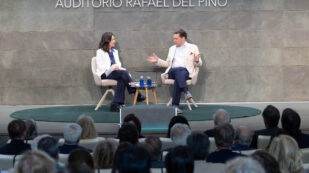
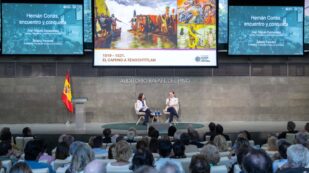
Dialogue between Juan Miguel Zunzunegui and Beatriz Paredes
Hernán Cortés, encounter and conquest
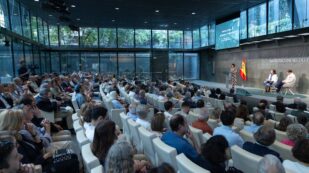
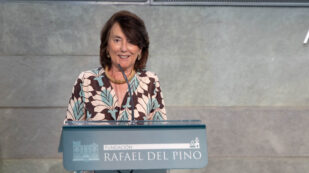
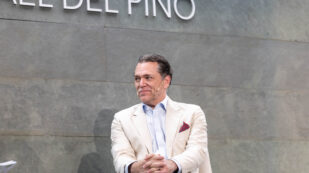
On 25 May 2026, the Rafael del Pino Foundation and the United for History Foundation organised the dialogue «Hernán Cortés, Encounter and Conquest», in which the following took part Juan Miguel Zunzunegui and Beatriz Paredes on the occasion of the presentation of Juan Miguel Zunzunegui's latest work of the same title.
Juan Miguel Zunzunegui is a Mexican writer, historian and academic. He holds a degree in Communication and a Master in Humanities from the Universidad Anahuac. He is also a specialist in philosophy from the Universidad Iberoamericana and holds a postgraduate degree in Marxism and Historical Materialism from the Fundación de Investigadores Marxistas and the Universidad Complutense de Madrid. He is a specialist in monotheistic religions from the Hebrew University of Jerusalem and holds a PhD in Humanities from the Universidad Latinoamericana (Mexico).
Beatriz Paredes Camuñas holds a degree in Law and an Executive MBA from the Instituto de Empresa. After a long career in the financial sector, specialising in capital markets, in 2020 she founded Unidos por la Historia, a Spanish cultural foundation aimed at strengthening social cohesion through a shared, rigorous and inclusive historical narrative. She directs and co-hosts the podcast Osos y Flamencos. Historia de la diversidad hispana, one of the main audiovisual channels of the project, which has reached more than four million views in its first season.
Summary:
The Fundación Rafael del Pino and the Fundación Unidos por la Historia organised the dialogue «Hernán Cortés, encuentro y conquista», with the participation of Juan Miguel Zunzunegui and Beatriz Paredes on the occasion of the presentation of the Mexican historian's latest work. The conversation offered a reflection on the figure of Hernán Cortés, the conquest of Mexico and the construction of historical narratives that, five centuries later, continue to influence the understanding of Hispanic identity.
A historical figure at the centre of contemporary debate
The persistence of Hernán Cortés in public debate was one of the starting points of the meeting. Beyond the historical figure, participants pointed out that the current controversies surrounding his figure reflect underlying issues related to collective memory, national identity and the interpretation of the past.
In this sense, it was highlighted how the discussion on the conquest of Mexico transcends the strictly historiographical sphere to become a reflection on the relations between Spain and America and on the meaning of a shared history that continues to generate conflicting interpretations.
Cortés' Intellectual Profile and Renaissance Spain
Juan Miguel Zunzunegui stressed the need to understand Hernán Cortés within the historical context of his time. In contrast to certain simplistic views, he stressed his university education in Salamanca, his knowledge of law and the classical tradition and his ability to manage in complex political scenarios.
As he explained, Cortés embodies some of the characteristic traits of Renaissance Spain: a spirit of initiative, a vocation for exploration and a remarkable combination of political pragmatism and personal ambition. His trajectory, he said, is difficult to understand without taking into account the process of expansion and transformation that the Hispanic Monarchy was undergoing at the beginning of the 16th century.
Conquest and the role of indigenous alliances
One of the most relevant aspects of the dialogue was the insistence on the political complexity of the conquest of Mexico. Zunzunegui questioned interpretations that present the fall of Tenochtitlan as the victory of a small group of Spaniards over a large indigenous empire.
On the contrary, he argued that the outcome of the conflict can only be explained through the alliances established between Cortés and numerous indigenous peoples who maintained tensions and confrontations with the Mexica power. The participation of the Tlaxcalans, Totonacs and other groups was presented as a decisive element in understanding the events of 1519-1521.
This perspective allows us to situate the conquest in a broader framework, characterised by the interaction between multiple political actors with their own interests.
Doña Marina and the mediation between two worlds
The conversation devoted special attention to the figure of Doña Marina, presented as one of the fundamental protagonists of that historical process.
Beyond her function as an interpreter, participants highlighted her role as a cultural mediator between two profoundly different universes. Her knowledge of the languages and political structures of Mesoamerica facilitated communication and allowed Cortés to navigate in an environment he was completely unfamiliar with.
The figure of Marina was also analysed as an example of the complexity of historical processes, far removed from contemporary categories that can hardly be applied to the context of the 16th century.
The encounter between Europe and Mesoamerica
The dialogue also addressed the symbolism of the encounter between Hernán Cortés and Moctezuma, interpreted as one of the most significant episodes in modern history.
The speakers described that moment as the convergence of two cultural, political and religious traditions that had little reference to each other. The entry of the Spaniards into Tenochtitlan and the impact of the vision of the great Mexica city illustrated, it was pointed out, the magnitude of that encounter between civilisations.
Admiration, uncertainty and mutual incomprehension were all part of an experience that would profoundly transform the history of both continents.
Crossbreeding and the construction of a new historical reality
One of the central themes of the session was mestizaje as a historical consequence of the process that began in the 16th century. Participants argued that the subsequent history of Mexico cannot be understood solely from the logic of confrontation, but also from the creation of new cultural, social and political forms resulting from the interaction between Europeans and indigenous peoples.
In this context, the Virgin of Guadalupe was presented as one of the most representative symbols of this process of cultural integration, capable of incorporating traditions from different historical and religious horizons.
History, memory and identity
The final part of the meeting was devoted to analysing the construction of the national narratives that emerged after the Spanish-American independences. According to Zunzunegui, many of the contemporary interpretations of the conquest respond to later political processes that sought to define new national identities by reinterpreting the past.
The figure of Hernán Cortés thus went from being the protagonist of a shared history to becoming an object of controversy within narratives that emphasised the break with Spanish heritage.
Understanding the complexity of the past
In conclusion, the dialogue vindicated the need to approach history from the standpoint of documentary rigour and critical analysis. In contrast to ideological simplifications and anachronistic readings, the participants argued for a more complex understanding of the events that gave rise to the Hispanic world.
Five centuries later, the figure of Hernán Cortés continues to raise debates that transcend history to delve into questions related to identity, memory and coexistence between cultural traditions. Precisely for this reason, the study of that process continues to offer valuable keys to understanding some of the intellectual and political challenges of the present.
The Rafael del Pino Foundation is not responsible for the comments, opinions or statements made by the people who participate in its activities and which are expressed as a result of their inalienable right to freedom of expression and under their sole responsibility. The contents included in the summary of this conference are the result of the debates held at the meeting held for this purpose at the Foundation and are the responsibility of their authors.
The Rafael del Pino Foundation is not responsible for any comments, opinions or statements made by third parties. In this respect, the FRP is not obliged to monitor the views expressed by such third parties who participate in its activities and which are expressed as a result of their inalienable right to freedom of expression and under their own responsibility. The contents included in the summary of this conference are the result of the discussions that took place during the conference organised for this purpose at the Foundation and are the sole responsibility of its authors.