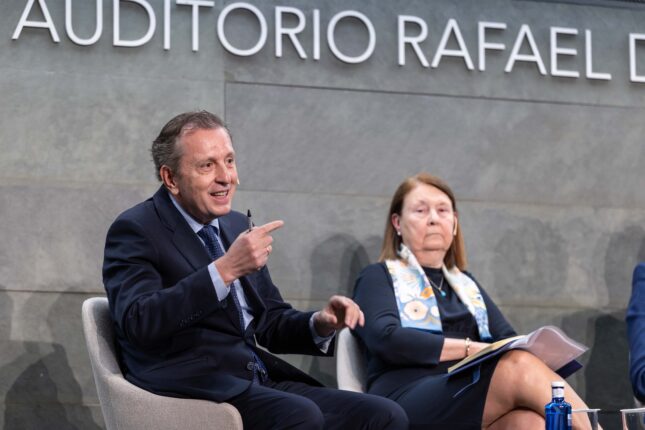
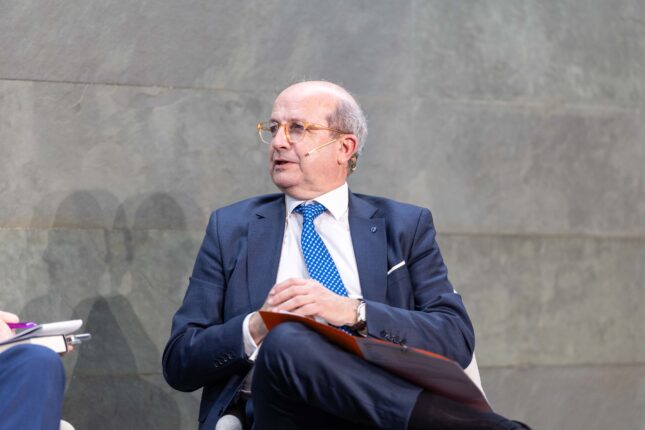
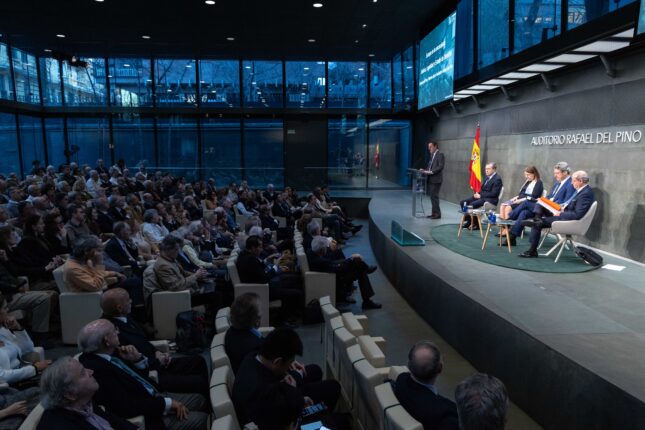
Dialogue between Rosario Silva de Lapuerta, Daniel Calleja and Javier Cremades
Europe at the crossroads: justice, legality and the rule of law
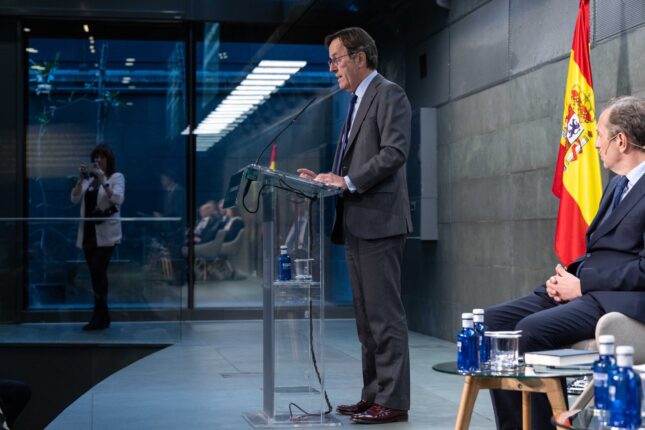
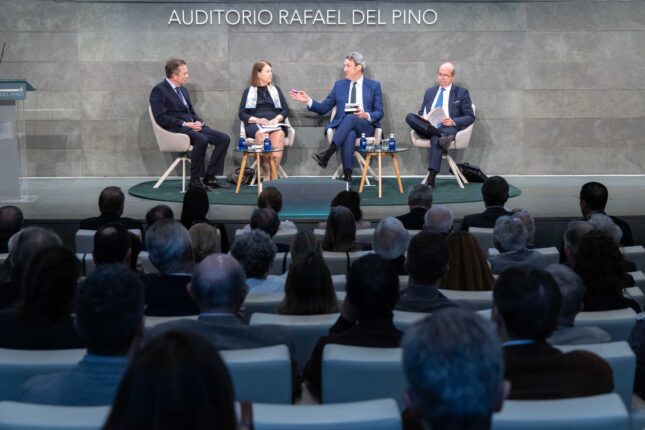
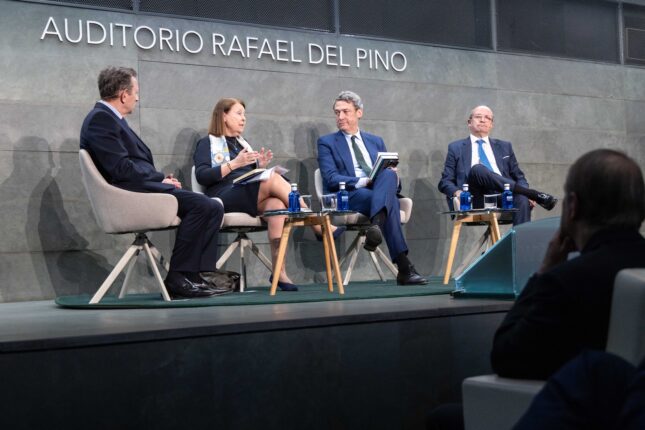
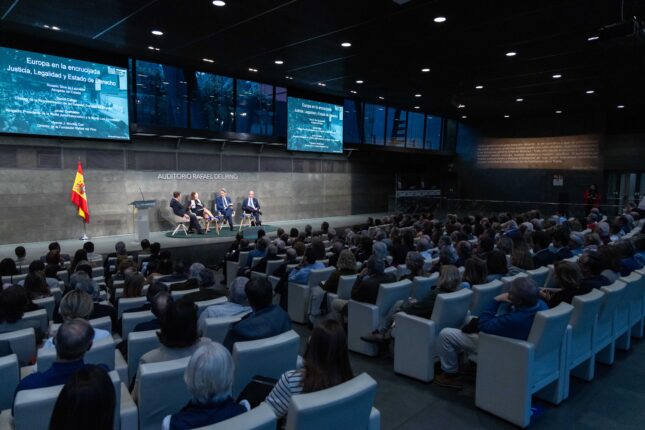
On 17 March 2026, the Rafael del Pino Foundation organised the dialogue «Europe at the crossroads: justice, legality and the rule of law» with the participation of Rosario Silva de Lapuerta, Daniel Calleja and Javier Cremares. On the occasion of the publication of the work by Javier Cremades entitled «Sobre el imperio de la ley», published by Galaxia Guteberg.
Rosario Silva de Lapuerta holds a degree in Law from the Complutense University of Madrid and is a State Lawyer. She has had an extensive career in the field of European Union law and was a Judge at the Court of Justice of the European Union from 2003 to 2021, where she was Vice-President and President of various Chambers. He has held important institutional responsibilities in the representation of the Kingdom of Spain before the European institutions and has actively participated in the work of reforming the European Union's judicial system. She also has an extensive teaching and academic career and has been awarded the highest civil and legal decorations of the Spanish State.
Daniel Calleja is Director of the Representation of the European Commission in Spain, which acts as the voice of the Commission in Spain, promotes permanent policy dialogue with national authorities, social partners, other stakeholders, academia and civil society. Between 2020 and 2025 he was Director General of the Legal Service advising the European Commission on all legal matters, responsible for the representation and defence of the European Commission before international jurisdictions. Between 2015 and 2020 he was Director General of the Directorate-General for Environment and, between 2012 and 2015, of the Directorate-General for Internal Market, Industry, Entrepreneurship and SMEs. He previously held other senior management positions in the European Commission, including Head of Cabinet to European Commission Vice-President Loyola de Palacio, Commissioner for Transport and Energy (between 2000 and 2004); Head of Cabinet to Commissioner Marcelino Oreja, Commissioner for Institutional Affairs, Audiovisual Policy and Relations with the European Parliament (between 1995 and 1999), and member of the Cabinet of Commission President Jacques Santer.he joined the Commission in 1986 as a member of its Legal Service, after passing the competition process. Prior to that, he was legal adviser to Procter and Gamble España from 1984 to 1986. In addition, Mr. Calleja has collaborated with various academic institutions by giving classes and lectures at universities and academic centres in Europe and also in the United States. He is co-author of several publications, including «70 years of EU Law» (2022) as well as numerous articles on European law and EU policies. Mr. Calleja holds a degree in Law and Business Studies from the Universidad Pontificia de Comillas (ICADE E3), and completed his studies at the City of London Polytechnic (London) and the Universidad Complutense de Madrid where he specialised in European Business Law and EU Law respectively.
Javier Cremades is chairman and founder of Cremades & Calvo-Sotelo Abogados, a prestigious international law firm with presence in 15 cities in 8 countries. With a PhD in Law from the University of Regensburg and the UNED, and Doctor Honoris Causa from the International University of Valencia, his career is characterised by an innovative approach to law based on global leadership, innovation and institutional commitment. He has been recognised as Lawyer of the Year by Forbes and Jurist of the Year by the World Jurist Association. He has been president of the World Jurist Association since 2019, and maintains an intense academic, institutional and editorial activity, as well as a strong commitment to strengthening the rule of law and civil society.
Summary:
On 17 March, the Rafael del Pino Foundation brought together three leading figures in the European legal field to address a structural issue for the Union: the validity and strength of the rule of law in a context of growing internal and external pressure.
The dialogue, held on the occasion of the publication of the book On the rule of law, by Javier Cremades (Galaxia Gutenberg), with the participation of Rosario Silva de Lapuerta, former vice-president of the Court of Justice of the European Union (CJEU); Daniel Calleja, director of the Representation of the European Commission in Spain; and Cremades himself, in a conversation moderated by Vicente Montes.
A community of law with a demanding legal basis
One of the initial consensuses was the characterisation of the European Union as a community of law, where the values enshrined in Article 2 of the Treaty on European Union - human dignity, freedom, democracy, equality and the rule of law - constitute effective legal obligations.
On this point, Rosario Silva de Lapuerta underlined the decisive role of the Court of Justice in consolidating this framework, highlighting the evolution of its case law on judicial independence and effective judicial protection. As she explained, the Court has reinforced the idea that these principles form part of the essential content of the European system, directly linking respect for the rule of law with the protection of fundamental rights.
Daniel Calleja, for his part, stressed the institutional singularity of the Union, pointing out that its functioning depends to a large extent on the effectiveness of the law as an instrument of integration. In his speech, he pointed out that the EU has no coercive power of its own, which makes compliance with the rules the central element of its operation.
From a more conceptual perspective, Javier Cremades emphasised the historical and cultural dimension of the Rule of Law, understanding it as the result of a prolonged evolution that places the dignity of the person as the ultimate limit of political power.
Oversight, compliance and institutional architecture
The debate also touched on the mechanisms designed to ensure respect for the rule of law in the Member States. Calleja detailed the main instruments available: infringement procedures before the CJEU, the annual report on the rule of law, the cross-compliance mechanism linked to EU funds and the Article 7 Treaty procedure.
These instruments, it was stressed, reflect a growing sophistication of the European control system, which combines preventive and corrective approaches. In parallel, Silva de Lapuerta recalled that a formal declaration of non-compliance by a Member State can only be made through infringement proceedings, underlining the importance of preserving the procedural architecture of the system.
Cremades, on the other hand, introduced a reflection on the tensions inherent in the European model, stressing that the Union is a unique legal construction based on the transfer of sovereignty, which inevitably generates frictions between normative and institutional levels.
Primacy of Union law and coherence of the system
Another of the central themes was the principle of the primacy of EU law. Calleja defined it as an indispensable functional requirement to guarantee the uniform application of the rules in all Member States, avoiding divergences of interpretation that could compromise the functioning of the internal market.
Along these lines, Silva de Lapuerta explained the role of the preliminary ruling mechanism as a key instrument for ensuring this uniformity, allowing national judges to turn to the CJEU to resolve interpretative doubts.
Cremades complemented this vision by introducing the concept of multilevel constitutionalism, The European Union, in which different centres of legal authority - national and European - coexist in a dynamic balance that requires constant dialogue.
Rule of law, competitiveness and geopolitical contextco
The dialogue also incorporated an economic and geopolitical dimension. Calleja argued that legal certainty, judicial independence and institutional transparency are not only regulatory principles, but also determinants of competitiveness, especially in a global environment characterised by uncertainty.
At the same time, Cremades warned about the risks of tension between power and law in crisis contexts, pointing out that situations such as war or exceptional measures can put the coherence of the system to the test.
Silva de Lapuerta agreed that times of crisis have historically acted as catalysts for European integration, allowing progress to be made in areas where there had previously been no common action.
Culture of legality and future challenges
In the final part of the meeting, the speakers converged on the need to strengthen the culture of legality as an essential element for the sustainability of the European model.
Calleja stressed the importance of the legitimacy of rules and civic commitment to their enforcement, beyond coercive mechanisms. Cremades insisted on the need to strengthen citizens' adherence to the European legal system, while Silva de Lapuerta pointed to the role of the Commission's reports as a roadmap for improving institutional quality in the Member States.
The debate concluded with a shared idea: the rule of law is not a given element, but a construction that requires constant maintenance. In an increasingly competitive international environment, its preservation is a necessary condition both for the internal cohesion of the Union and for its global projection.
The Rafael del Pino Foundation is not responsible for the comments, opinions or statements made by the people who participate in its activities and which are expressed as a result of their inalienable right to freedom of expression and under their sole responsibility. The contents included in the summary of this conference are the result of the debates held at the meeting held for this purpose at the Foundation and are the responsibility of their authors.
The Rafael del Pino Foundation is not responsible for any comments, opinions or statements made by third parties. In this respect, the FRP is not obliged to monitor the views expressed by such third parties who participate in its activities and which are expressed as a result of their inalienable right to freedom of expression and under their own responsibility. The contents included in the summary of this conference are the result of the discussions that took place during the conference organised for this purpose at the Foundation and are the sole responsibility of its authors.