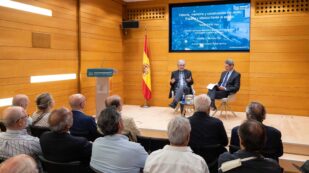
History, memory and the construction of the story. Spain and Mexico in the mirror
On 23 June 2026, the Rafael del Pino Foundation organised the keynote lecture «History, memory and the construction of the story. Spain and Mexico in the mirror"which was given by Tomás Pérez Vejo.
Tomás Pérez Vejo D. in History from the Complutense University of Madrid and is currently professor-researcher in the Postgraduate Programme in History and Ethnohistory at the National School of Anthropology and History of Mexico (ENAH-INAH), a programme recognised as a Postgraduate Programme of International Competence. He is also a member of Mexico's National System of Researchers, where he holds the distinction of National Researcher Level III. Throughout his academic career he has carried out research and teaching work in various European and American institutions. He has been visiting professor at the Consejo Superior de Investigaciones Científicas de España (CSIC), the École des Hautes Études en Sciences Sociales (EHESS) in Paris, the University of Cantabria, El Colegio de México, the Universidad Autónoma del Estado de Morelos and the University of Lyon, among others. His main lines of research focus on the processes of national construction in Ibero-America during the 19th and 20th centuries, relations between Mexico and Spain, and the political uses of images. He is considered one of the leading specialists in the study of nationalism, the narratives of nationhood in Spain and Mexico and the historical relations between the two countries. His publications include Nationhood, national identity and other nationalist myths (1999), Creole elegy (2010), Spain imagined. History of the invention of a nation (2015), Urban republics in an imperial monarchy (2019) y 3 July 1898. The end of the Spanish Empire (2020). In recognition of his intellectual career, he received the Encomienda de la Orden de Isabel la Católica in 2012 and the Mexican Order of the Aztec Eagle in 2018.
Summary:
On 23 June 2026, the Rafael del Pino Foundation organised the keynote lecture «History, memory and the construction of narrative. Spain and Mexico face to face», organised by Tomás Pérez Vejo, a historian and specialist in the processes of nation-building in the Hispanic world. Throughout his talk, the speaker analysed the complex relations between Spain and Mexico from the perspective of historical memory and the narratives of identity that both countries have constructed around a shared past.
The central thesis of his presentation was that the tensions which periodically arise between the two nations are not the result of conflicts of economic, geopolitical or ideological interests, but rather stem from a deeper issue: the different ways in which Spaniards and Mexicans interpret a shared history and incorporate it into their respective national narratives.
From historical conflicts to identity conflicts
Pérez Vejo pointed out that, during the 19th century and the early decades of the 20th century, there were objective reasons that explain much of the friction between the two countries. Spanish interference in Mexican politics, the economic and social prominence of certain Spanish communities established in Mexico, and strategic interests linked to Cuba all contributed to generating mistrust and clashes.
However, once these circumstances had ceased to exist, the tensions did not subside. On the contrary, they continued to manifest themselves at various points in the political life of both countries. For the historian, this persistence demonstrates that the root of the discord lies in the realm of collective identities and national narratives rather than in the existence of actual conflicts between the states.
One shared history, two different memories
One of the central themes of the conference was the distinction between history and memory. Spain and Mexico share the same history, but they do not share the same memory of it.
As Pérez Vejo explained, the major events shared by both societies — the conquest, the viceregal period and independence — occupy very different places in their respective collective imaginations. Whilst independence constitutes one of the pillars of Mexican identity and is barely present in the Spanish historical consciousness, the conquest remains the major shared event, albeit interpreted from opposing perspectives.
Mexican historical memory has tended to portray the conquest as the event that brought an end to an indigenous civilisation, whilst Spanish tradition long regarded it as one of the principal feats of its historical expansion. This divergence explains why the same event can play radically different symbolic roles in the construction of both national identities.
The founding narratives of the Mexican nation
The construction of Mexican national identity formed a substantial part of the presentation. Pérez Vejo explained how, since independence, two major narratives regarding the origin and nature of Mexico have coexisted.
The first viewed the Mexican nation as the heir to viceregal Spain, understanding independence as the emancipation of a historical community that had reached political maturity. The second, which would eventually prevail, interpreted national history as a process of birth, death and resurrection: birth in the pre-Hispanic world, disappearance with the conquest, and revival with independence.
The consolidation of this latter narrative made it possible to place the indigenous past at the heart of Mexican national identity and transformed independence into a moment of restoration for a nation that had previously been disrupted. In the speaker’s view, this narrative continues to exert a decisive influence on the country’s political culture and public memory.
Mestizaje as a project for national integration
Faced with the difficulty of reconciling seemingly contradictory historical legacies, a new interpretation of Mexican identity based on mestizaje emerged in the late 19th and early 20th centuries.
This perspective proposed understanding Mexico as the result of the fusion between the indigenous and Spanish worlds, thereby overcoming the opposition between them. Mestizaje thus became one of the central themes of Mexican national discourse and a means of integrating diverse historical traditions within a single political community.
However, Pérez Vejo pointed out that this synthesis never completely eliminated the tensions arising from differing interpretations of the past. The ongoing debates surrounding the conquest, the viceregal legacy and the Spanish heritage demonstrate that the question of identity continues to play a significant role in Mexican public life.
The imperial past in the construction of Spanish identity
The conference also devoted considerable attention to the Spanish case. Although Mexico does not occupy a central position in the construction of Spanish national identity, the imperial past certainly does, and within that context, the territory of New Spain historically played a fundamental role.
Pérez Vejo explained how the Spanish elites of the 19th century incorporated the imperial experience into the national narrative and made the expansion into the Americas one of the defining elements of Spanish history. In this context, the conquest of the Americas became part of a national epic that identified the imperial past with one of the country’s most historically significant periods.
The symbolic significance of figures such as Hernán Cortés, or the very celebration of 12 October, reflects the importance that the imperial legacy has had in shaping Spain’s national narrative. This interpretation, the historian pointed out, is in many respects the inverse reflection of the prevailing memory in Mexico.
Memory, politics and contemporary debates
Towards the end of his speech, Pérez Vejo addressed the impact that contemporary schools of thought have had on these issues. In his view, the rise of decolonial theories and policies centred on vindicating historical victims has helped to reignite debates on conquest, colonisation and responsibilities for the past.
These processes have heightened the prominence of identity issues in public debate and have brought new relevance to historical discussions that seemed to have been left behind. The result is a growing political use of memory, particularly in contexts where national identities become instruments of social and political mobilisation.
Beyond our shared past
In conclusion, Tomás Pérez Vejo argued that the relationship between Spain and Mexico can only be fully understood if one recognises the influence that national narratives exert on the interpretation of the past. Despite sharing an extraordinarily close history, both countries have constructed distinct and, at times, conflicting memories of some of its key events.
The conference highlighted how collective memory continues to play a decisive role in shaping contemporary identities and in the way societies interpret both their past and their relationships with others. From this perspective, understanding the narratives that each nation constructs about itself is an essential prerequisite for understanding its relations with the wider world.
The Rafael del Pino Foundation is not responsible for the comments, opinions or statements made by the people who participate in its activities and which are expressed as a result of their inalienable right to freedom of expression and under their sole responsibility. The contents included in the summary of this conference are the result of the debates held at the meeting held for this purpose at the Foundation and are the responsibility of their authors.
The Rafael del Pino Foundation is not responsible for any comments, opinions or statements made by third parties. In this respect, the FRP is not obliged to monitor the views expressed by such third parties who participate in its activities and which are expressed as a result of their inalienable right to freedom of expression and under their own responsibility. The contents included in the summary of this conference are the result of the discussions that took place during the conference organised for this purpose at the Foundation and are the sole responsibility of its authors.