The relevance of the School of Salamanca in today’s world
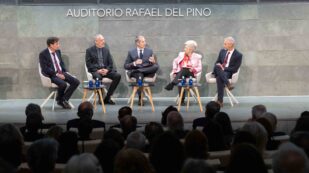
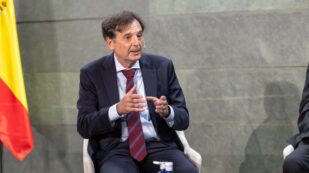
Araceli Mangas, Luis Perdices de Blas, Ricardo Rivero Ortega, Rodrigo Tena and Jaime Sánchez Santiago
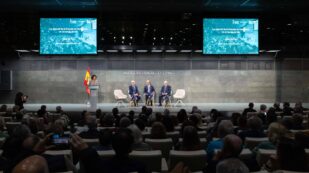
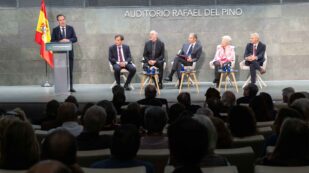
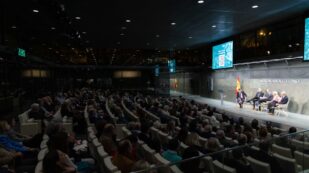
The Rafael del Pino Foundation, Alumni – University of Salamanca and the Hay Derecho Foundation organised, on the day 3 November 2026, the meeting «The relevance of the School of Salamanca in today’s world», in collaboration with the Chair in Business Innovation: 500th Anniversary of the School of Salamanca.
Programme
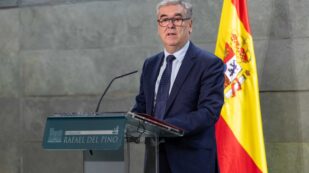
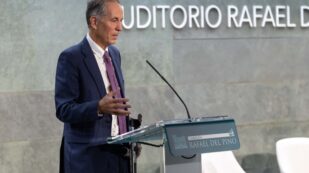
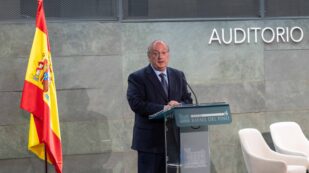
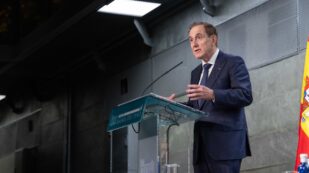
Institutional welcome
Maria del Pino, Chair of the Rafael del Pino Foundation.
Alfredo Ávila, General Secretary of USAL
Segismundo Álvarez, president of the Hay Derecho Foundation.
Enrique Cabero, Chair of the Economic and Social Council of Castile and León and Vice-Chair of the Alumni Advisory Board at the University of Salamanca.
Round-table discussion: The relevance of the School of Salamanca in today’s world
Chaired by Jaime Sánchez Santiago, Secretary of Alumni Affairs – University of Salamanca.
The following spoke:
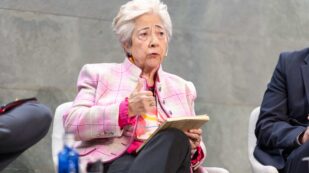
Araceli Mangas, Professor of Public International Law and International Relations at the Universities of Salamanca and Complutense in Madrid, and a member of the Royal Academy of Moral and Political Sciences. She will discuss the influence of the Salamanca School on human rights and international law.
Luis Perdices de Blas, Professor of the History of Economic Thought at the Complutense University of Madrid. He will analyse the contributions of the Salamanca School to the development of economic thought.
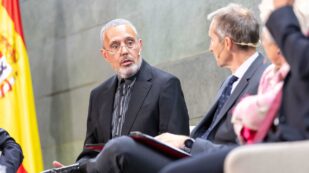
Ricardo Rivero Ortega, Professor of Administrative Law at the University of Salamanca. He will examine the influence of the Salamanca School in the philosophical, moral and legal spheres.
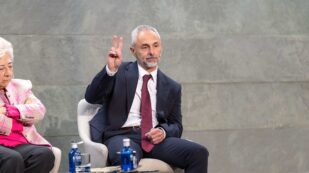
Rodrigo Tena, a notary and patron of the Hay Derecho Foundation. He will reflect on the contribution of the School of Salamanca to the defence and strengthening of the rule of law today.
Following the presentations, there was a question-and-answer session with the audience.
Closure
Antonio Huertas, Chair of the Salamanca School Alumni Association
Summary:
The Rafael del Pino Foundation, Alumni – University of Salamanca and the Hay Derecho Foundation organised, on 3 November 2026, the event «The Relevance of the School of Salamanca in Today’s World», in collaboration with the Chair of Business Innovation: 5th Centenary of the School of Salamanca.
The conference, held to mark the 500th anniversary of Francisco de Vitoria’s arrival at the University of Salamanca in 1526, brought together leading experts to analyse the influence of this school of thought on international law, the economy, individual rights and the rule of law, as well as the continued relevance of its contributions in the face of contemporary challenges.
The School of Salamanca and the foundations of international law
Araceli Mangas, Professor of Public International Law and International Relations at the Universities of Salamanca and Complutense in Madrid, examined the influence of Francisco de Vitoria on the development of international law and the recognition of human rights.
Mangas highlighted the innovative nature of Vitoria’s thinking, particularly his defence of the essential equality of all human beings and political communities, regardless of their origin, culture or religion. Against the backdrop of the conquest of the Americas, his reflections challenged the traditional claims that sought to justify the domination of other peoples and rejected the notion that imperial or papal authority alone could legitimise the conquest.
The professor explained that Vitoria envisaged the existence of an international community governed by principles and obligations that took precedence over the individual will of states. His thinking thus anticipated some of the foundations of the contemporary international legal order, such as the limitation of state sovereignty, the protection of the common good and the need to preserve peace.
He also analysed their contributions to the law of war, particularly the requirement for a just cause to resort to force, the principle of proportionality, the responsibility of those who decide to initiate conflicts, and the need to achieve reconciliation once they have ended.
Mangas pointed out that many of these ideas took centuries to be effectively incorporated into international practice, but played a decisive role in the development of international law during the 19th and 20th centuries and, in particular, within the United Nations system.
The financial contributions of the Salamanca scholastics
Luis Perdices, Professor of the History of Economic Thought at the Complutense University of Madrid, discussed the contributions of the School of Salamanca to the analysis of markets, prices, currency and trade relations.
In response to the view that the Scholastics rejected trade and economic activity, Perdices explained that their criticisms were directed primarily against certain practices contrary to justice, and not against commercial exchange in itself.
Among his principal contributions, his monetary explanation of inflation stood out; this was developed on the basis of the arrival of precious metals from the Americas and the consequent increase in the money supply. He also analysed his reflections on the ‘fair price’, understood by some authors as the price freely established in the market, provided that transactions were carried out without coercion or deception.
Perdices also examined the development of scholastic positions on lending and the charging of interest, as well as their reflections on the responsibility of rulers in the administration of public resources.
In this regard, he recalled the contributions of Juan de Mariana, who questioned the manipulation of the value of money and advocated for spending restraint, the monitoring of public finances and the fight against fraud.
The economist emphasised that the School of Salamanca did not constitute a homogeneous school of thought and pointed out the need to distinguish between conceptual similarities with current economic theories and historical evidence of a direct influence on them.
Individual freedom, rights and the common good
Ricardo Rivero, Professor of Administrative Law at the University of Salamanca, reflected on the contributions of the School of Salamanca to the theory of subjective rights and to the relationship between individual freedom and the common good.
Rivero placed the development of this intellectual movement within the context of the Dominican tradition, emphasising the importance of study, freedom of thought and the possibility of dissent within the academic community. In his view, these conditions fostered the emergence of critical thinking capable of challenging even the leading political and religious authorities of his time.
In the legal sphere, he examined the influence of the philosophy of St Thomas Aquinas and the debates with nominalism on the shaping of individual rights. He paid particular attention to Vázquez de Menchaca’s contribution to the development of the concept of subjective rights.
Rivero emphasised that one of the most significant contributions of the School of Salamanca was its ability to reconcile personal freedom with the demands of the common good. From this perspective, individual rights cannot be understood in isolation, but rather within the framework of a community in which their exercise must be compatible with the rights and freedoms of others.
In the ensuing debate, he argued for the need to restore two essential principles of that intellectual tradition to contemporary education: a rigorous commitment to study and the freedom to express dissenting views.
Salamanca’s approach to the challenges facing the rule of law
Rodrigo Tena, a notary and patron of the Hay Derecho Foundation, focused his speech on the continued relevance of the ideas of the School of Salamanca in understanding and addressing the current challenges facing the rule of law.
Tena analysed the tensions which, in his view, affect the functioning of contemporary democracies, including the proliferation of regulations, the weakening of institutional checks and balances, and the growing concentration of executive power.
In response to these trends, he reaffirmed two fundamental principles of scholastic thought: the orientation of political institutions towards the common good and the intrinsically limited nature of public power.
He explained that, for the thinkers of Salamanca, the common good did not constitute an unlimited justification for state intervention, but rather an end subject to legal rules and procedures. Power must be exercised in accordance with the law and with respect for individual freedom; the legitimacy of its origin could not justify arbitrary actions.
He also emphasised the importance of a broad conception of institutional accountability, in which the abuse of power is not limited to explicitly criminal conduct, but also encompasses the use of public office for private ends that are contrary to the public interest.
During the discussion, Tena emphasised the need to strengthen institutional culture and the role of civil society in safeguarding the limits of power.
An intellectual legacy to tackle contemporary challenges
The debate, moderated by Jaime Sánchez Santiago, Secretary of Alumni at the University of Salamanca, provided an opportunity to explore in depth the reasons for the belated recognition of some of the contributions made by the School of Salamanca, its influence on various economic and legal schools of thought, and the possibilities for applying its principles to education and the functioning of today’s institutions.
The participants emphasised the importance of critical thinking, rigorous scholarship, the accountability of those in power, and the need to establish effective checks and balances on the exercise of power. The contributions also highlighted the diversity of interpretations that the Salamanca legacy allows for and the importance of studying it within its historical context, whilst avoiding automatically applying contemporary ideological categories to it.
The meeting provided an opportunity to rediscover the universal dimension of a school of thought which, having emerged five centuries ago, addressed issues that continue to occupy a central place in contemporary debate: human dignity, justice, freedom, economic relations, the common good and the limits of power.
Beyond their historical significance, the presentations demonstrated how the work of the School of Salamanca can contribute to a rigorous examination of the foundations of institutions and the challenges facing contemporary societies.
The Rafael del Pino Foundation is not responsible for the comments, opinions or statements made by the people who participate in its activities and which are expressed as a result of their inalienable right to freedom of expression and under their sole responsibility. The contents included in the summary of this conference are the result of the debates held at the meeting held for this purpose at the Foundation and are the responsibility of their authors.
The Rafael del Pino Foundation is not responsible for any comments, opinions or statements made by third parties. In this respect, the FRP is not obliged to monitor the views expressed by such third parties who participate in its activities and which are expressed as a result of their inalienable right to freedom of expression and under their own responsibility. The contents included in the summary of this conference are the result of the discussions that took place during the conference organised for this purpose at the Foundation and are the sole responsibility of its authors.