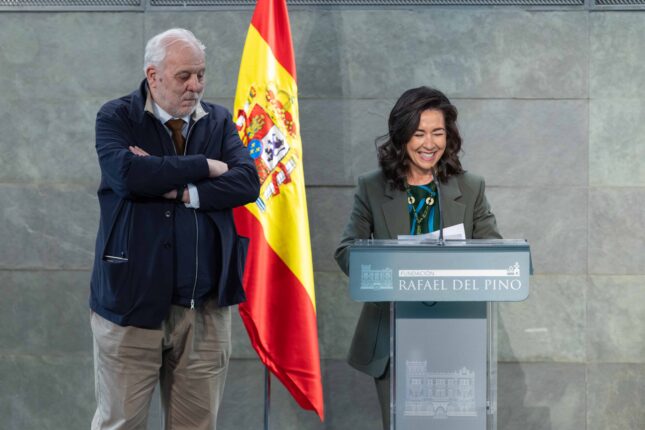
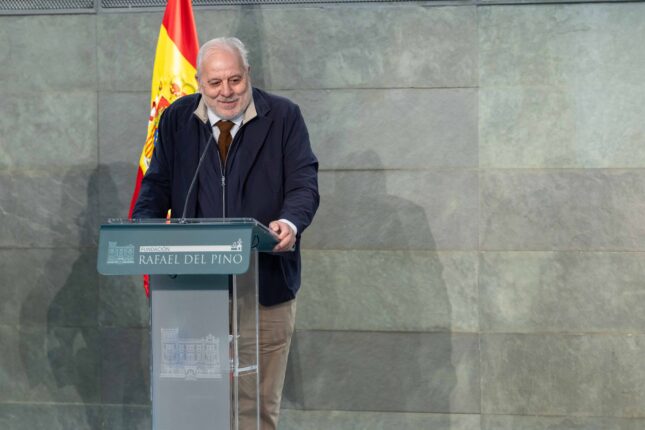
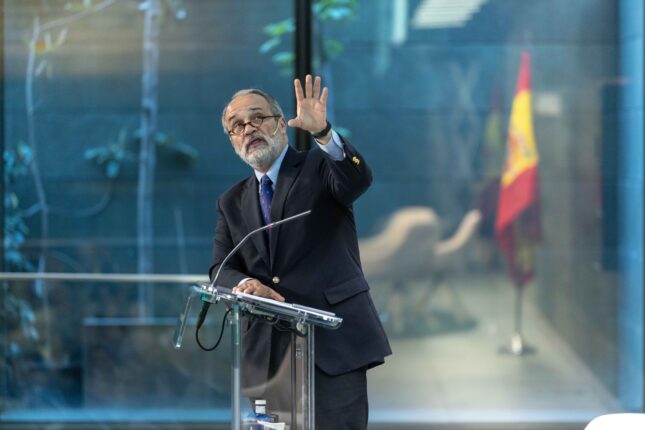
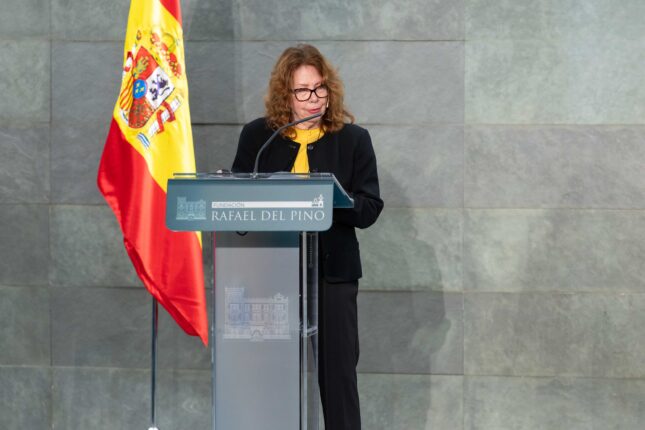
Dialogue between Gonzalo Quintero and Jane Landers
The United States and Spain, 250 years of shared history
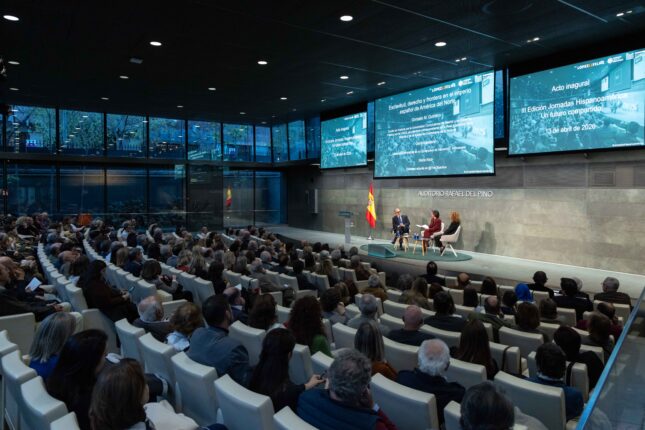
The Rafael del Pino Foundation, Lopez-li Films and the United for History Foundation organised the event “The United States and Spain, 250 years of shared history» on 13 April 2026, in which the following will participate Gonzalo Quintero y Jane Landers.
The event took place according to the following programme:
19.00 h. Words of welcome
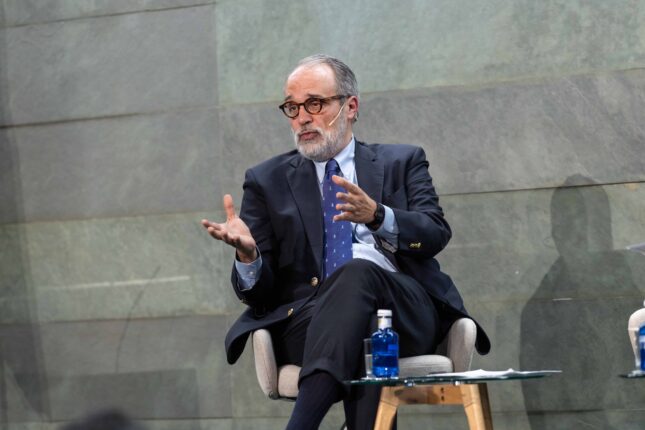
19.05 h.Gonzalo Quintero Lecture: “Spain in the American War of Independence”.”
19.30 h.Jane Landers Lecture: “Why Africans defended Spanish America against British colonisation”.”
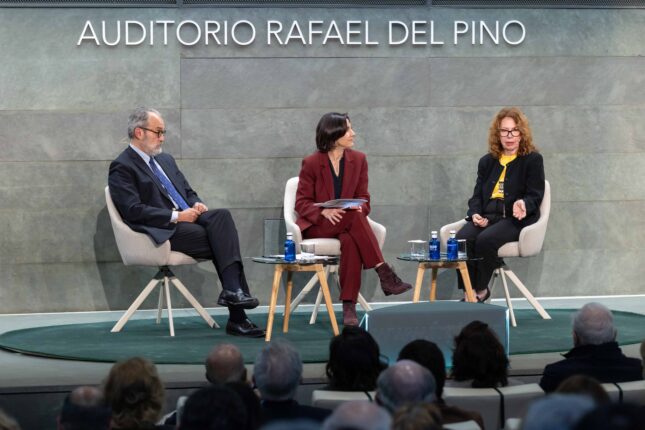
19.55 h.Dialogue “Beyond slavery: Spanish legacies in the social and cultural history of the United States”.” With Jane Landers, Gonzalo Quintero and Maite Rico (moderator)
Gonzalo M. Quintero SaraviaD. in History from the Complutense University of Madrid and in Public Law from the UNED, is a corresponding member of the Royal Academy of History and the Colombian Academy of History. He has been a fellow of the Weatherhead Center for International Affairs at Harvard University. His book Bernardo de Gálvez: Spanish Hero of the American Revolution was awarded the Society for Military History's Distinguished Book Award for the best biography published in 2018 (published by Alianza Editorial with the title Bernardo de Gálvez: A Spanish Hero in the American War of Independence). Recent publications include: with Professor Gabriel Paquette Spain and the American Revolution: New Approaches and Perspectives (New York: Routledge, 2019 and Charlottesville, VA: University of Virginia Press, 2022); "The Participation of France and Spain", in Wim Klooster ed. The Age of Atlantic Revolutions. Vol. 1. The Enlightenment and the British Colonies (Cambridge: Cambridge University Press, 2023: 269-295) and with Professor Kathleen DuVal, "Bernardo de Gálvez: Friend of the American Revolution, Friend of Empire", in Andrew N. O'Shaughnessy, John A. Ragosta and Marie-Jeanne Rossignol eds. European Friends of the American Revolution (Charlottesville & London: University of Virginia Press, 2023, 147-174).
Jane Landers is a professor of history at Vanderbilt University and director of the Slave Societies Digital Archive, one of the most relevant international projects dedicated to the preservation of historical documents on slavery in the Atlantic world. A specialist on colonial Latin America and the African diaspora, her work focuses on the history of Africans and their descendants in the slave societies of the Americas. She is the author of widely acclaimed and award-winning reference works such as Atlantic Creoles in the Age of Revolutions y Black Society in Spanish Florida. His research has been supported by institutions such as the Guggenheim Foundation, the National Endowment for the Humanities and the Andrew W. Mellon Foundation. He is also a member of UNESCO's International Scientific Committee for the Routes of Enslaved Peoples. Through his digital archive, Landers leads the preservation of unique records, some dating back to the 16th century, from countries such as Cuba, Brazil, Colombia and Cape Verde, making a decisive contribution to the study of slavery and historical memory in the Atlantic.
Maite Rico, Deputy Director of THE OBJECTIVE. Specialised in international news, Maite Rico has developed her career in the two main Spanish newspapers. She was a columnist and deputy editor of EL MUNDO between 2021 and 2024, where she founded the cultural magazine La Lectura, awarded the LIBER Prize by the Spanish Federation of Publishers' Guilds. She previously worked at EL PAÍS, where she was deputy editor between 2014 and 2018. She was in charge of the renovation of EL PAIS SEMANAL and launched the supplement Ideas. Previously, she was an editorialist, correspondent in Mexico, Central America and the Caribbean, and special envoy for Latin America coverage. As a reporter she has also covered the wars in Bosnia, Somalia and Libya. She collaborates with Onda Cero, EsRadio and TeleMadrid. With a degree in Geography and History from the Complutense University of Madrid, and a master's degree in Journalism from the Autonomous University of Madrid / EL PAÍS, she is co-author, with Bertrand de la Grange, of the books Marcos, the brilliant imposture (Aguilar, 1998; and Plon, Paris, 1998), on the Zapatista Army of National Liberation (EZLN), and Who killed the bishop? Autopsy of a political crime (Planeta, 2003), about the assassination of the Guatemalan bishop Juan Gerardi.
Summary:
The commemoration of the 250th anniversary of the independence of the United States offers a privileged opportunity to reconsider, from a renewed historiographical perspective, the nature of the links between Spain, Latin America and the Anglo-Saxon world. This is the context of the third edition of the conference “Hispanic America: a shared future”.”, The exhibition, inaugurated at the Fundación Rafael del Pino and organised in collaboration with López-Li Films and the Fundación Unidos por la Historia.
Far from reproducing traditional readings that focus exclusively on British and Anglo-American colonial protagonism, the meeting proposes a reinterpretation of the American independence process as a phenomenon embedded in a broader Atlantic dynamic, in which the Spanish monarchy played a structural role.
The geostrategic dimension of the Spanish intervention
Gonzalo Quintero's intervention placed the analysis within the framework of 18th century imperial geopolitics, underlining that Spanish participation in the American War of Independence cannot be understood in merely subsidiary terms with respect to France, but as the result of a strategy of its own.
Spain articulated a complex system of support for the American insurgents that combined financial aid, the supply of armaments, the opening of trade routes and direct military operations, especially in the Gulf of Mexico and Florida. This approach shows that the conflict was, in reality, a global war in which the European powers were settling the balance of power in the Atlantic.
It also highlighted the importance of figures such as Bernardo de Gálvez, whose actions were decisive in the British containment of southern North America, as well as the importance of the diplomatic and commercial networks that sustained the war effort.
Slavery, law and the frontier in the Hispanic world
For her part, Jane Landers offered an analysis focused on the social and legal dimension of the Spanish Empire, particularly with regard to the African populations on the North American frontiers. Her presentation highlighted the substantive differences between the Spanish and British slave systems, underlining the legal - and not strictly racial - nature of slavery in the Hispanic sphere.
In this context, the role of communities such as Gracia Real de Santa Teresa de Mosé, a settlement of runaway slaves taken in by the Spanish Crown under conditions of religious conversion and military service, was examined. These dynamics reflect the existence of spaces for negotiation and social mobility that, without questioning the institution of slavery, introduced elements of legal flexibility absent in other colonial models.
The intervention also highlighted the importance of free black militias and religious networks in shaping frontier societies, as well as their contribution to the defence of the territory against British expansion.
Memory, forgetting and the reconstruction of the historical narrative
The subsequent dialogue, moderated by Maite Rico, addressed the causes of the relative ignorance of this shared legacy, both in Spanish and American historiography. Among the factors pointed out were the fragmentation of academic traditions, language barriers and the persistence of exclusionary national narratives.
It was stressed, however, that in recent decades there has been a growing convergence between historiographical communities on both sides of the Atlantic, favoured by access to common sources and a greater internationalisation of research.
Dissemination and public projection of historical knowledge
The day also served as a framework for the presentation of the documentary film Hispanics, by José Luis López-Linares, which constitutes an important effort to transfer historical knowledge to the public sphere. The combination of academic rigour and a vocation for dissemination is presented, in this sense, as a key tool for the revision of collective imaginaries and the broadening of historical debate.
Conclusion: towards an integrated Atlantic history
Overall, the meeting reaffirms the need to integrate the Hispanic legacy into the understanding of the history of the United States and, more broadly, of the Atlantic space. This perspective not only enriches historical analysis, but also contributes to questioning simplistic views, proposing instead a more complex, relational and global approach.
The shared history between Spain, Latin America and the United States thus emerges not as a peripheral element, but as a constitutive dimension of Atlantic modernity.
The Rafael del Pino Foundation is not responsible for the comments, opinions or statements made by the people who participate in its activities and which are expressed as a result of their inalienable right to freedom of expression and under their sole responsibility. The contents included in the summary of this conference are the result of the debates held at the meeting held for this purpose at the Foundation and are the responsibility of their authors.
The Rafael del Pino Foundation is not responsible for any comments, opinions or statements made by third parties. In this respect, the FRP is not obliged to monitor the views expressed by such third parties who participate in its activities and which are expressed as a result of their inalienable right to freedom of expression and under their own responsibility. The contents included in the summary of this conference are the result of the discussions that took place during the conference organised for this purpose at the Foundation and are the sole responsibility of its authors.