


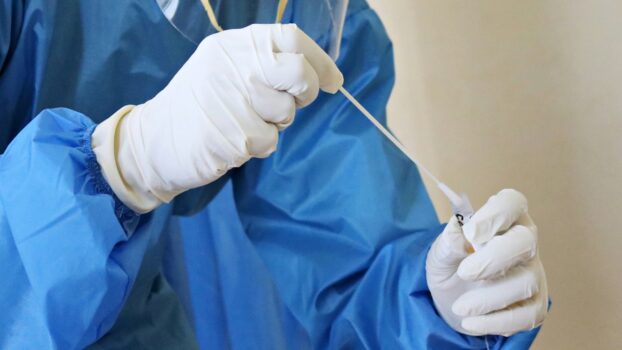
Imagine going to the doctor’s surgery, providing a single drop of saliva or blood and to obtain an accurate diagnosis for several conditions at once in just a few minutes, without the need to send samples to a laboratory or wait days for the results. This approach, known in the healthcare sector as point-of-care testing, and which we have discussed in our INTEC report at on more than one occasion, is coming ever closer to becoming an everyday reality thanks to a breakthrough that combines the physics of light with microelectronics: silicon photonics.
A research team involving the expert at the Science and Society Chair of the Rafael del Pino Foundation and the National Research Prize, Laura Lechuga, has given a decisive step by developing a portable prototype capable of simultaneously and independently identifying up to seven different biological markers in a single sample.
To validate the effectiveness of this technology in a real-world clinical setting, the scientists tested the device against the Respiratory Syncytial Virus, a pathogen responsible for common and potentially serious respiratory infections in infants and the elderly. The biosensor demonstrated exceptional sensitivity. It was able to detect microscopic concentrations of the virus’s proteins simultaneously across all seven of its analysis channels.
The secret behind this breakthrough lies in to make use of the same technology used to manufacture microchips for traditional computers and smartphones, known as CMOS technology. The difference lies in the fact that, rather than conducting electricity, these tiny silicon circuits conduct light pulses via microscopic channels known as waveguides. As the sample passes through these optical channels, any biomolecule or virus that adheres to the surface alters the behaviour of the light, enabling an immediate, highly accurate reading without the need for any chemical markers or dyes.
To date, ensuring that a single microchip can analyse multiple targets at the same time It presented enormous technical challenges. Efficiently directing light to several tiny sensors without the signals becoming distorted or interfering with one another was one of the main obstacles. Added to this was the difficulty of integrating microscopic channels to transport the sample fluids evenly and ensure that the surface of each sensor reacted only to the target pathogen.
To overcome these barriers, the researchers designed a comprehensive platform that addresses each critical issue. At the heart of the system is a new bimodal waveguide chip, which utilises changes in the properties of light travelling through the circuit to detect the presence of pathogens with a negligible margin of error. This component was combined with an optimised microfluidic system and an optical reading architecture specifically designed to eliminate interference between adjacent sensors.
The result is an integrated, compact device which demonstrates how the analytical capabilities of an advanced laboratory can be packed into a portable device. The consolidation of this technology paves the way for a new generation of medical equipment capable of being deployed in primary care centres, A&E departments or areas with limited resources, revolutionising the rapid detection of infectious diseases and speeding up medical decision-making when every minute counts.