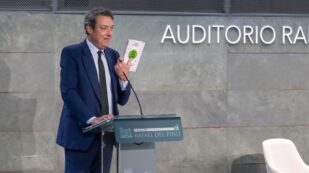
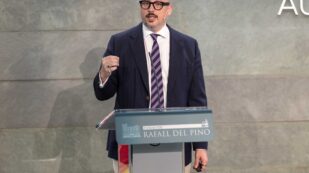
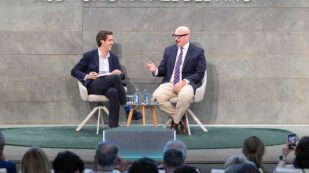
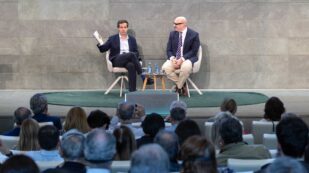
On 15 April 2026, the Rafael del Pino Foundation organised the Master Conference “Digital economy and business growth. Creativity, data analysis and new challenges for marketing”, which will be given by Alex Schultz on the occasion of his latest work «Click here. The Art and Science of Digital Marketing and Advertising»published by Deusto. After the conference he spoke with Pablo Rivas.
Alex Schultz is chief marketing officer and vice president of analytics at Meta, a role he has held since 2020. He leads the areas of marketing, product analytics, global experience, insights and content worldwide. As VP of Analytics, Alex has built Meta's engineering and data science teams, which he now leads, to define strategies, develop business and competitive intelligence actions, and generate more engagement and growth for users. Alex has nearly 20 years of experience in the direct response marketing industry and is responsible for the global marketing organisation, which promotes Meta's products and services to customers and businesses. Since joining Meta in 2007, Alex has pioneered the integration of direct response marketing and products into the company. He has played a key role in bringing the Facebook, Instagram and Messenger app to more than 1 billion users. Specifically, Alex and his team led the company's name change from Facebook to Meta in 2021. He is also the author of “Click Here: The Art and Science of Digital Marketing and Advertising”. He holds an MSc in Natural Sciences from Magdalene College, Cambridge, and specialises in experimental and theoretical physics. He is based in his home town of London.
Pablo Rivas is founder of Global Alumni, an edtech that collaborates with some of the world's top universities to expand their education globally. With academic experience at institutions such as UC Berkeley, Loyola Chicago and Harvard, and an MBA, he has focused his career on driving quality digital education. His work focuses on adapting learning to the needs of the Fourth Industrial Revolution and strengthening the skills of 21st century professionals.
Summary:
The Rafael del Pino Foundation organised, on 15 April 2026, the master conference “Digital economy and business growth. Creativity, data analysis and new marketing challenges”.”, The event, given by Alex Schultz on the occasion of the publication of his work Click here. The Art and Science of Digital Marketing and Advertising (Deusto). In his speech, Schultz -one of the main international benchmarks in analytics and growth- offered an in-depth reflection on the role of marketing in the digital economy and the challenges faced by companies in an increasingly complex and technologically advanced environment.
Marketing as a driver of economic growth
From the outset, the speaker defended a clear idea: economic growth remains a desirable goal, and marketing, far from being an ancillary activity, is one of its main drivers. In particular, he highlighted the capacity of personalised digital marketing to connect people with relevant products and services, to drive business and job creation, and to contribute to sustaining the economic system. This claim places marketing on a structural level, as a key player in the generation of value.
The importance of distinguishing between targets and metrics
From this premise, Schultz focused his analysis on one of the most widespread problems in organisations: the confusion between objectives and metrics. He stressed the importance of precisely defining the company's “North Star” - its ultimate purpose - and differentiating it from the indicators used to measure progress. While the purpose responds to the raison d'être of the organisation, metrics are approximations that can be misleading if they become an end in themselves. This phenomenon, known as Goodhart's law, explains why many companies end up optimising variables that do not reflect the real impact of their activity.
In this regard, the speaker criticised the use of superficial metrics and defended the need to focus on indicators that capture real behaviour, such as active users as opposed to simple registrations. However, he warned that even the best metrics have limitations, which means that they should be interpreted with caution and complemented by more sophisticated analysis.
Incrementality: Measuring the real impact of marketing
One of the key concepts of the conference was incrementality, understood as the ability to measure what impact marketing has actually had versus what would have happened in its absence. Schultz questioned traditional attribution models - especially last-click-based attribution - for their tendency to overvalue certain channels and ignore upstream demand generation work.
Against this simplified view, he advocated the adoption of experimental methodologies to isolate the causal effect of marketing, such as A/B testing, on/off testing of campaigns or comparison between equivalent markets. This approach is particularly relevant in a context where financial areas are demanding greater accountability for return on investment. In the words of the speaker, the fundamental question that must guide any strategy is: “what would have changed if marketing had not existed?.
Analytical rigour and measurement risks
The conference also addressed the risks associated with poor analytical practice, in particular the so-called p-hacking, which consists of manipulating or biased interpretation of statistical results in order to obtain favourable conclusions. Schultz insisted on the need to maintain methodological rigour, to define hypotheses and metrics in advance, and to avoid the temptation to select only those data that validate a particular narrative.
Without this rigour, he warned, data loses its strategic value and can lead to wrong decisions.
Artificial intelligence: a paradigm shift
In the second part of his speech, the focus shifted to artificial intelligence, presented as a factor in the radical transformation of marketing. Schultz highlighted the speed at which these technologies are evolving and their impact on areas such as media buying, content personalisation and process automation. In many cases, he said, artificial intelligence is already outperforming human capabilities in specific tasks, which is redefining the rules of the game.
However, he also stressed that artificial intelligence is not a substitute for judgement and creativity. The ability to ask the right questions, choose relevant problems and make strategic decisions remains essentially human.
Preparing for the future: technology, talent and culture
Looking to the future, Schultz said organisations need to prepare by adapting their systems, developing continuous assessment mechanisms, implementing feedback loops and combining business and artificial intelligence talent.
At the individual level, he encouraged professionals to actively experiment with these tools, at a time when their adoption is still in its infancy and offers significant opportunities for differentiation.
Culture as a competitive advantage
Ultimately, the conference left a clear message: success in the digital economy does not depend solely on technology or data, but on organisational culture. Fostering environments that question the real impact of actions, value analytical rigour and encourage experimentation is, according to Schultz, the key to successfully meeting the challenges of contemporary marketing.
The Rafael del Pino Foundation is not responsible for the comments, opinions or statements made by the people who participate in its activities and which are expressed as a result of their inalienable right to freedom of expression and under their sole responsibility. The contents included in the summary of this conference are the result of the debates held at the meeting held for this purpose at the Foundation and are the responsibility of their authors.
The Rafael del Pino Foundation is not responsible for any comments, opinions or statements made by third parties. In this respect, the FRP is not obliged to monitor the views expressed by such third parties who participate in its activities and which are expressed as a result of their inalienable right to freedom of expression and under their own responsibility. The contents included in the summary of this conference are the result of the discussions that took place during the conference organised for this purpose at the Foundation and are the sole responsibility of its authors.