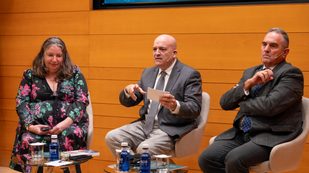
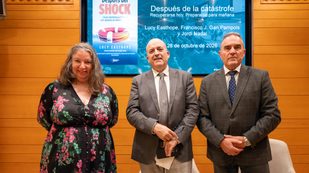
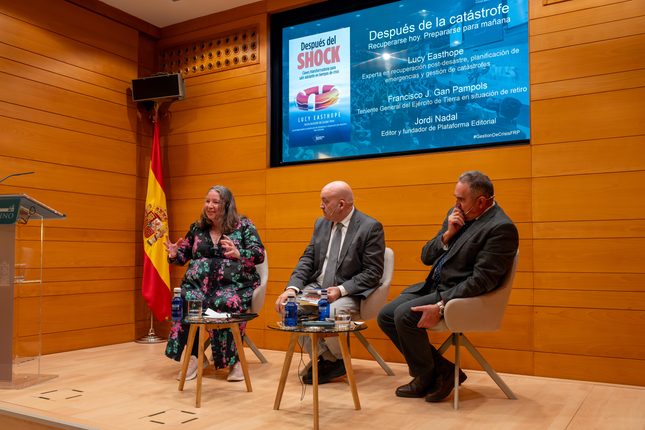
A conversation between Francisco J. Gan Pampols and Lucy Easthope
After the disaster. Recovering today. Preparing for tomorrow
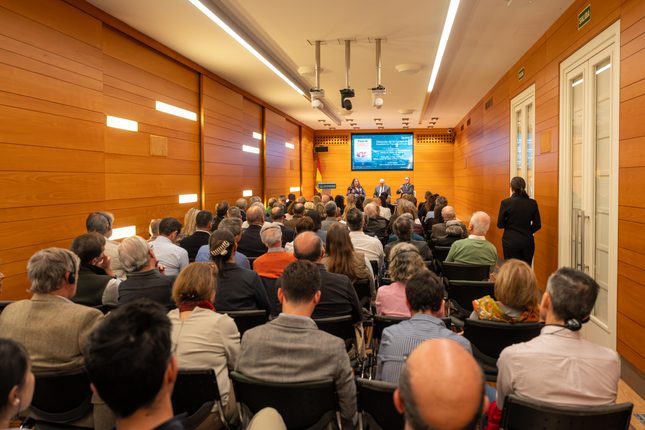
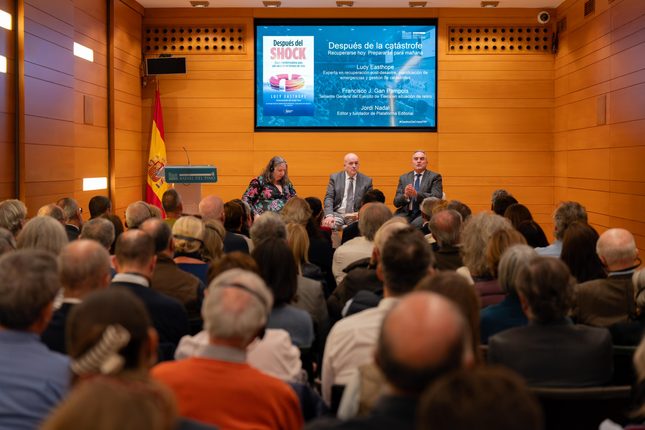
On 28 October 2026, the Rafael del Pino Foundation organised the discussion «After the catastrophe. Recovering today. Preparing for Tomorrow», featuring Lucy Easthope, Francisco J. Gan Pampols and Jordi Nadal, to mark the publication of Lucy Easthope’s latest book of the same title, published by Plataforma Editorial.
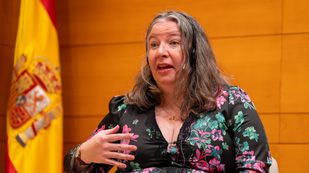
Lucy Easthope (1979) is a British lecturer and consultant specialising in post-disaster recovery, emergency planning and the management of mass casualty incidents. With a degree in Law, a Doctorate in Medicine and a Master’s degree in risk, crisis and disaster management, she has advised on some of the greatest tragedies of recent decades, such as 9/11, the 7 July London bombings, the Christchurch earthquake, the Grenfell Tower fire and the Covid-19 pandemic. She grew up in Liverpool and her career was shaped by the Hillsborough tragedy of 1989. She is currently Professor in Practice of Risk and Hazards at Durham University and a Fellow in Mass Casualty Disasters and Pandemics at the University of Bath. He has worked with governments and international organisations, advocating for recovery models centred on people and communities. He lives in the Welsh Marches with his family.
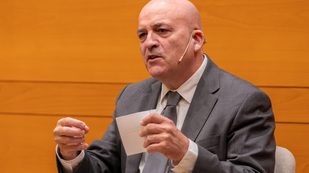
Francisco J. Gan Pampols He is a retired Lieutenant General of the Army. Lieutenant General Gan, born in Figueres (Girona) in 1958, entered the General Military Academy in 1975 and enjoyed a long and distinguished career in the Army, rising to the rank of Lieutenant General in 2016. Throughout his career, he held various senior posts, including Director of the General Military Academy, Director of the Armed Forces Intelligence Centre and Head of the Land Forces High Readiness Headquarters. He took part in various international missions in Bosnia and Herzegovina, Kosovo and Afghanistan. He holds a degree in Political Science and Sociology from the UNED and has, amongst others, the Army General Staff Diploma and the Advanced National Defence Course Diploma. He is also renowned for his achievements in mountaineering and polar exploration. He has reached the summits of Shishapangma and Everest, as well as the South and North Poles. In 1999, he became the first Spaniard and the fifth person in the world to complete the so-called «three poles of the Earth»: Everest, the South Pole and the North Pole. His numerous honours include various Spanish and foreign decorations, as well as the United Nations Medal and several NATO Medals. He holds an honorary doctorate from the Catholic University of Valencia, is a member of the Civic Opinion Circle, and is a Corresponding Member of the Luis Vélez de Guevara Royal Academy of Sciences, Fine Arts and Literature in Écija.
Summary:
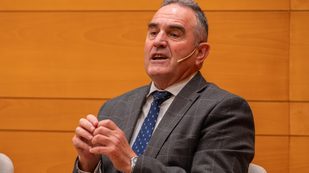
On 28 October 2026, the Rafael del Pino Foundation organised a discussion entitled «After the catastrophe. Recovering today. Preparing for tomorrow», featuring Lucy Easthope, an international expert in emergency management and recovery following major disasters; Francisco J. Gan Pampols, a retired lieutenant-general and former Vice-President of the Valencian Regional Government for economic and social recovery following the DANA of 2024; and Jordi Nadal, publisher and founder of Plataforma Editorial, who moderated the event.
The discussion was held to mark the publication in Spanish of *Después del shock*, Lucy Easthope’s latest book, published by Plataforma Editorial, and addressed the human, institutional and strategic challenges involved in a society’s recovery following a catastrophe.
Drawing on their respective experiences, the participants reflected on the importance of anticipating risks, strengthening institutions’ response capacities, exercising responsible leadership in situations of uncertainty, and ensuring that support for those affected continues long after the emergency has ended.
Recovery begins when public attention wanes
Lucy Easthope explained that disasters do not end when the media stops showing images of destruction or when essential services are restored. Recovery is a long, uneven and deeply personal process that can last for years or even decades.
The British specialist described the different stages that affected communities go through. Following an initial phase characterised by collective mobilisation, heroism and solidarity, there is usually a period of disillusionment, exhaustion and a feeling of abandonment. It is precisely at this point that people need more sustained support.
Easthope questioned the idea that overcoming a tragedy necessarily means emerging from it stronger. In his view, recovery does not require forgetting what happened or finding a positive meaning in the suffering, but rather learning to live with the losses and gradually rebuilding one’s life.
In this regard, he emphasised the need to pay particular attention to the less visible victims, including children, vulnerable people and those who continue to suffer the psychological consequences of a disaster long afterwards.
From spontaneous solidarity to institutional responsibility
Francisco J. Gan Pampols addressed the issue of recovery from the perspective of organisation, planning and the responsibilities of public authorities, drawing on his experience leading the reconstruction efforts following the DANA that affected the Valencian Community in October 2024.
The Lieutenant-General explained that the transition from the emergency phase to the recovery phase takes place gradually, as essential services are restored and communities are able to resume their activities. However, he warned that this process is not progressing at the same pace across all regions or for everyone.
For Gan Pampols, the waning of spontaneous solidarity must give way to an organised institutional response, capable of identifying needs, setting priorities, mobilising resources and maintaining commitments over several years.
He argued that reconstruction must be tackled in a comprehensive manner, addressing five key areas: people, infrastructure, the economy, society and the natural environment.
He also emphasised that the Government must provide clear, accessible and accurate information, whilst taking care not to raise expectations it cannot fulfil. Public trust, he pointed out, depends as much on the effectiveness of its actions as on the honesty with which decisions are communicated.
Institutions prepared to act in exceptional circumstances
One of the main topics discussed at the meeting was the ability of institutions to respond to crises that go beyond the procedures and resources envisaged for normal circumstances.
Gan Pampols argued for the need to strengthen coordination between public authorities and proposed the creation of a state emergency agency with permanent capacity for planning, mobilising resources and managing major crises.
In his view, planning should be carried out centrally, whilst implementation should be decentralised in order to make the most of the knowledge and skills of those working directly on the ground. This division of responsibilities must not dilute the accountability of decision-makers.
He also highlighted the importance of having inventories of critical resources, pre-identified professional teams, organised networks of volunteers and administrative procedures that are sufficiently flexible to respond to extraordinary circumstances.
For his part, Easthope emphasised the importance of incorporating the knowledge gained from other international disasters into emergency management. He pointed out that many of the problems that arise during a crisis have already been studied elsewhere and advocated continuous training, open to scientific research and practical experience.
Both agreed that preparedness cannot be limited to having written plans in place: it is essential to practise them, review them and adapt them to changing threats.
Leading in times of uncertainty: making decisions, taking responsibility and telling the truthd
The discussion also addressed the challenges faced by leaders when decisions have to be made on the basis of incomplete information and under enormous pressure.
Lucy Easthope warned of the danger of confusing hope with unfounded optimism. Whilst she considered it essential to offer people a vision of the future, she insisted that public decision-makers must acknowledge the uncertainty and also consider the worst-case scenarios.
Gan Pampols maintained that the ability to make decisions in extreme situations is built up through experience, preparation and ongoing training. In his view, making mistakes can be part of the learning process, but inaction in the face of an emergency is unacceptable.
He also argued that delegating tasks does not mean shifting ultimate responsibility for decisions. Leadership requires taking responsibility for the consequences of decisions, acknowledging mistakes and acting with transparency.
The participants agreed that institutional credibility depends on the ability to communicate the reality of the situation without concealing its difficulties, and to offer responses based on technical criteria, free from political confrontation.
Rebuilding a community involves much more than simply restoring its infrastructure
Another key issue was how to determine when a community has truly recovered.
Easthope pointed out that physical reconstruction does not always go hand in hand with emotional recovery. A home may once again be habitable and a road may be reopened, but people continue to live with their losses, their memories and the consequences of what has happened.
Gan Pampols agreed that the recovery has a fundamental intangible dimension. By way of example, he pointed out that one of the most significant signs of the recovery in Valencian municipalities was the return of their traditions, their marching bands, their festivals and their community activities.
The restoration of these social and cultural ties is a sign that a community is beginning to regain its identity and its everyday life.
The participants also considered whether it was appropriate to rebuild certain infrastructure or settlements in areas exposed to recurring risks. Gan Pampols argued that it is not always appropriate to restore conditions to those that existed before a disaster and that, in certain cases, it is necessary to rethink land use in order to reduce future vulnerability.
Turning experience into knowledge and prevention
Towards the end of the meeting, Lucy Easthope and Francisco J. Gan Pampols examined why societies find it so difficult to learn from disasters and prevent the same mistakes from being repeated.
Easthope highlighted the value of sharing experiences, preserving the memory of what happened, and translating scientific knowledge into language that is understandable to the public and institutional decision-makers. He also emphasised the importance of personal stories in understanding the consequences of disasters and improving future responses.
Gan Pampols explained that a lesson can only be considered truly learnt when, after identifying and analysing a problem, it is incorporated into procedures, put into practice and its effectiveness is tested through exercises and drills.
Both emphasised the need to develop a genuine culture of prevention, based on training, risk anticipation and the preparation of the necessary human and material resources.
In conclusion, Easthope emphasised the importance of learning how to provide better support, whilst avoiding interventions which, although well-intentioned, may hinder the recovery of affected communities. Gan Pampols called for prevention to be placed at the heart of public policy, through a combination of information, training, planning and the effective capacity to take action.
The meeting highlighted that a society’s resilience does not depend solely on its ability to respond to an emergency, but also on the strength of its institutions, the quality of its leadership and its long-term commitment to those affected. Preparing for the next disaster requires, above all, learning from previous ones and translating that learning into concrete decisions that will better protect the public.
The Rafael del Pino Foundation is not responsible for the comments, opinions or statements made by the people who participate in its activities and which are expressed as a result of their inalienable right to freedom of expression and under their sole responsibility. The contents included in the summary of this conference are the result of the debates held at the meeting held for this purpose at the Foundation and are the responsibility of their authors.
The Rafael del Pino Foundation is not responsible for any comments, opinions or statements made by third parties. In this respect, the FRP is not obliged to monitor the views expressed by such third parties who participate in its activities and which are expressed as a result of their inalienable right to freedom of expression and under their own responsibility. The contents included in the summary of this conference are the result of the discussions that took place during the conference organised for this purpose at the Foundation and are the sole responsibility of its authors.