Dialogue between Axel Kaiser, Esperanza Aguirre, Daniel Lacalle and María Blanco
Liberal Voices. The Myth of Ideological Extremes
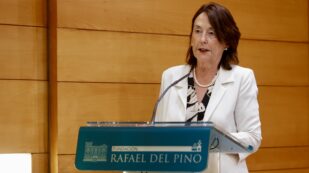
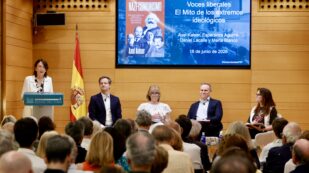
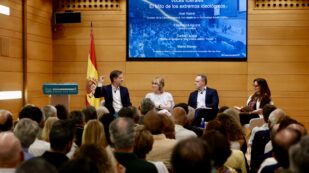
The Rafael del Pìno Foundation organised a discussion entitled «Liberal Voices: The Myth of Ideological Extremes. The Totalitarian Affinity between Marxist-Leninists and Nazi-Fascists», in which the following will take part: Axel Kaiser, Esperanza Aguirre y Daniel Lacalle moderated by María Blanco, on the occasion of the presentation of the latest work by Axel Kaiser «Nazi-Communism. Why Nazis, Leninists, and Nazi Fascists are ideological twins» edited by Duesto.
Axel Kaiser is a Chilean-German lawyer, PhD in philosophy from the University of Heidelberg, director of the Friedrich von Hayek Chair at the Universidad Adolfo Ibáñez and senior fellow of the Atlas Center for Latin America, based in Miami. He has been a visiting professor at the Hoover Institution at Stanford University and is co-founder and president of the Fundación para el Progreso, one of the most influential liberal think tanks in Latin America. He is a columnist for the newspapers Financial y The Mercury and his opinions have been published in international media such as The Wall Street Journal, Forbes.com, The Washington Post,La Nación of Argentina, El País of Uruguay y The World, among others. He is also an international lecturer and author of several bestsellers. His work has been published in Spain by Deusto in titles such as Mental parasites (2025), The street economist (2022), The neo-inquisition (2020), The tyranny of equality (2017) o Populist deception (2016). Nazi-communism (2026) is his latest book.
Daniel Lacalle D. in Economics, Chief Economist at Tressis S.V., professor of Global Economics at IE and IEB and investment fund manager. He holds a degree in Business Administration from the Universidad Autónoma de Madrid and a PhD Cum Laude from the Universidad Católica de Valencia. He is Chairman of the Instituto Mises Hispano, member of the Advisory Board of the Rafael del Pino Foundation and of ORFIN. He is also a member of the Academic Council of the International Freedom Foundation (FIL). His career in portfolio management and investment began at the hedge fund Citadel and continued at Ecofin Ltd. and PIMCO in the US and London. He is ranked number 5 in the Richtopia 2020 ranking of the world's most influential economists. He has been voted for five consecutive years among the top three managers in the Extel Survey, the Thompson Reuters ranking in the general strategy, oil and power categories. He writes a weekly column in El Español, and contributes monthly to CNBC and Bloomberg TV, as well as Antena 3, Cuatro, Telecinco, BBN Times, World Economic Forum, Hedge Eye, Epoch Times and Mises Wire, among others. Daniel Lacalle is the author of books on economics translated into several languages, including: "Nosotros los mercados", "Viaje a la libertad económica", "La gran trampa", "Libertad o Igualdad", and the latest, "Haz crecer tu dinero" (Deusto, 2022).
Esperanza Aguirre and Gil de Biedma (Madrid, 1952) holds a degree in Law from the Complutense University of Madrid and was admitted by competitive examination to the Corps of State Information and Tourism Technicians. She spent her early professional years in the Ministry of Culture. She began her political career in 1983 as a councillor in Madrid City Council, where she held various posts. In 1996 she was appointed Minister of Education and Culture. Between 1999 and 2002 she was President of the Senate, the first woman to hold this position. In 2003 she was invested President of the Community of Madrid, a position she held until 2012, leading important reforms in infrastructure, education and health. Between 2004 and 2016 she was president of the Partido Popular of Madrid. In 2015 she headed the PP's candidacy for the Madrid City Council as a mayoral candidate, and in addition to her political career, she is the author of several books on liberal thought and political current affairs.
María Blanco holds a PhD in Economics and Business Studies from the Complutense University of Madrid and lectures in Economic History and Institutions at the CEU-San Pablo University. She combines academic teaching and research with the dissemination of liberalism in various media. She is the author of Las tribus liberales (Deusto, 2014) and Afrodita desenmascarada (Deusto, 2016), and co-author of Hacienda somos todos, cariño (Deusto, 2020).
Summary:
The Rafael del Pino Foundation held another edition of the series «Liberal voices» on the occasion of the presentation of the book Nazi-Communism. Why Nazis, Leninists and Nazi-fascists are ideological twins, by Axel Kaiser, published by Deusto. Alongside the author, the following took part in the event:, Esperanza Aguirre y Daniel Lacalle, in a discussion moderated by María Blanco.
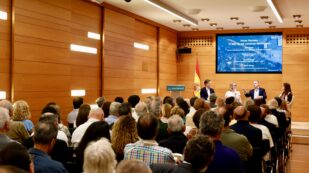
The session attracted a large audience to reflect on one of the most controversial issues in contemporary political history: the doctrinal and practical similarities between the great totalitarian regimes of the 20th century and their possible influence on current ideological debates.
A review of the intellectual roots of totalitarianism
Axel Kaiser explained that the main aim of his work is to systematically analyse the common elements which, in his view, are shared by Marxist-Leninist communism and Nazi-fascist movements. He argued that, despite the historical, national and strategic differences that set them apart, both political systems are underpinned by the same underlying logic, characterised by the subordination of the individual to the collective, the concentration of political power and the aim of comprehensively reorganising society.
The author argued that both communism and Nazism-fascism emerged as revolutionary movements that rejected the principles of classical liberalism, particularly individual freedom, the limitation of state power, private property and political pluralism. In this regard, he argued that understanding the affinities between these two ideologies is essential for interpreting some of the major ideological conflicts of the 20th century and for understanding certain political phenomena of the present day.
The five pillars of ideological affinity
During the discussion, Kaiser outlined the five elements he identifies as common denominators between the two political traditions: the rejection of individualism in favour of collectivism, hostility towards capitalism and the market economy, the questioning of liberal rationality, opposition to the Christian roots of Western civilisation, and the aspiration to build a “new man” through political action.
On the basis of these points, the author argued that both movements developed projects of social transformation of a totalising nature, in which the State assumed a predominant position over individual freedom and in which politics became an instrument for the comprehensive reshaping of society.
Liberalism versus totalitarianism
One of the central themes of the discussion was the vindication of liberalism as a political tradition geared towards the protection of human dignity, the limitation of power and the defence of an open society.
The participants agreed that contemporary liberal democracies face significant challenges arising from political polarisation, institutional weakening, a loss of trust in the elites, and the spread of ideological currents that call into question some of the foundations of the liberal order that emerged after the Second World War.
In this context, the importance of preserving institutions capable of guaranteeing pluralism, respect for individual rights and the peaceful coexistence of diverse ways of life was emphasised.
The culture war and the role of ideas
A significant part of the debate centred on the role of ideas in shaping political and social change. Both Kaiser and Lacalle argued that cultural transformations often precede institutional changes and emphasised the importance of actively participating in public debate to uphold the principles of a free society.
The speakers also analysed the influence of universities, the media and social media on the education of younger generations, as well as the impact that certain intellectual currents have had on the evolution of Western political thought over recent decades.
The discussion also covered recent developments in various Latin American countries, particularly in Chile and Argentina, where political changes have been accompanied by intense debates on the role of the state, economic freedom and the limits of public intervention.
Patriotism, national identity and immigration
Towards the end of the meeting, issues relating to national identity, patriotism and immigration were discussed. The participants drew a distinction between patriotism – understood as a commitment to the traditions, institutions and values of a political community – and exclusionary forms of nationalism that identify other groups as enemies.
Discussions also centred on the right of democratic societies to preserve their institutions and cultural frameworks, as well as on the challenges posed by migration in a context of increasing globalisation.
A debate on the relevance of political ideas
The session concluded with a wide-ranging discussion with the audience, during which questions were raised about the evolution of contemporary ideologies, the future of liberalism, political leadership and the lessons that can be learnt from the historical experience of totalitarian regimes.
Throughout the meeting, it was clear that there was a desire to foster a rigorous intellectual debate on issues that remain the subject of discussion in Western democracies. From different perspectives, the participants agreed on the need to continue reflecting on the role of political ideas, the defence of freedom and the challenges facing open societies in the 21st century.
The Rafael del Pino Foundation is not responsible for the comments, opinions or statements made by the people who participate in its activities and which are expressed as a result of their inalienable right to freedom of expression and under their sole responsibility. The contents included in the summary of this conference are the result of the debates held at the meeting held for this purpose at the Foundation and are the responsibility of their authors.
The Rafael del Pino Foundation is not responsible for any comments, opinions or statements made by third parties. In this respect, the FRP is not obliged to monitor the views expressed by such third parties who participate in its activities and which are expressed as a result of their inalienable right to freedom of expression and under their own responsibility. The contents included in the summary of this conference are the result of the discussions that took place during the conference organised for this purpose at the Foundation and are the sole responsibility of its authors.