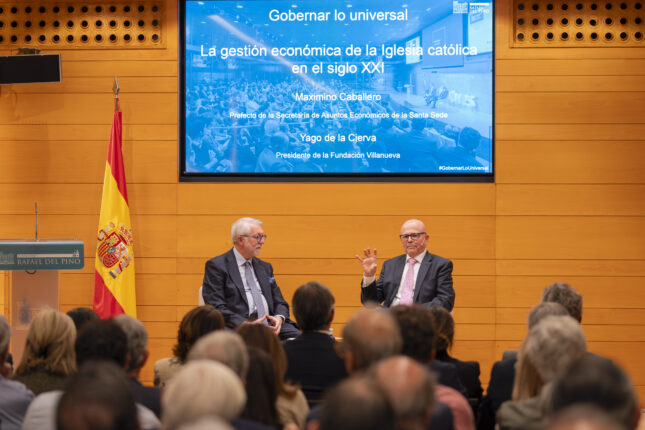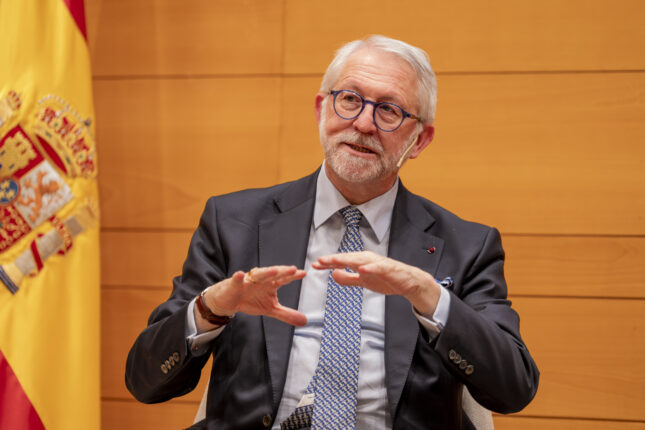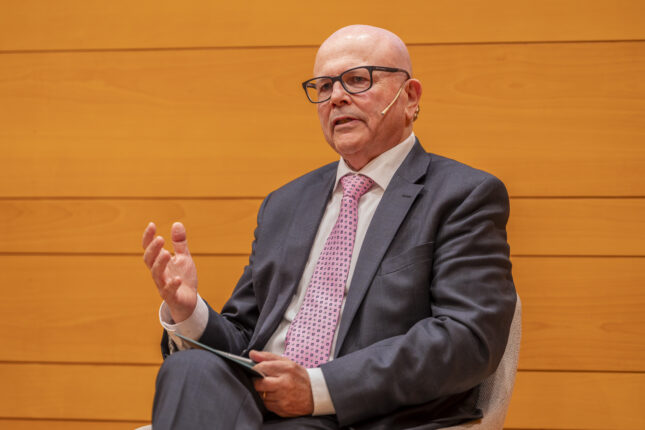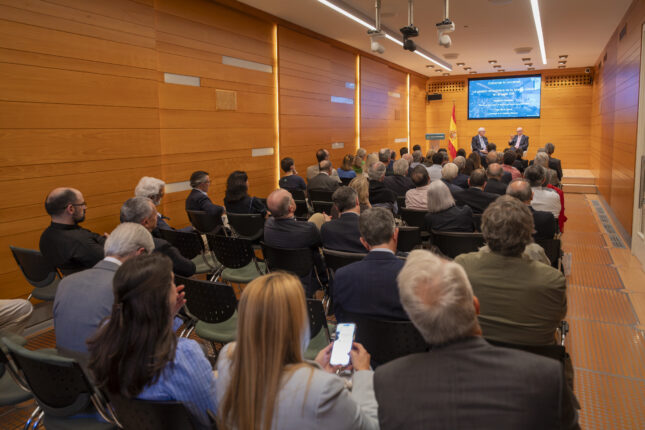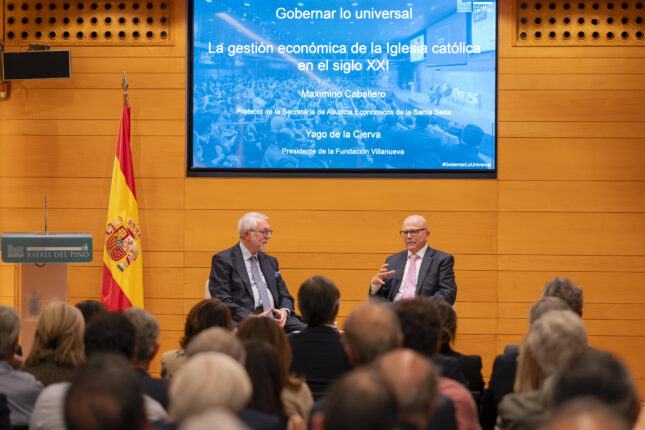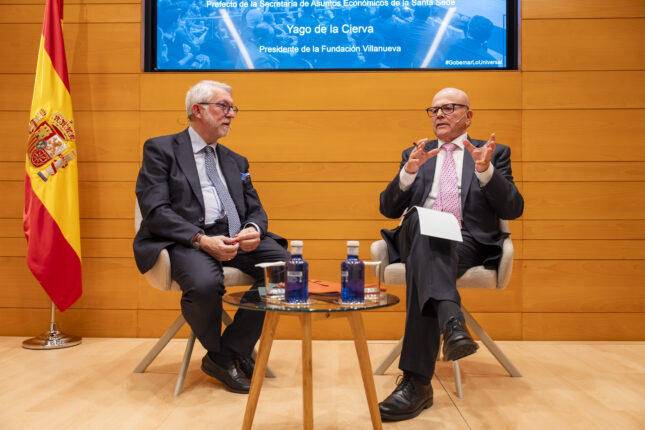


Dialogue between Maximino Caballero and Yago de la Cierva

Governing the universal. The economic management of the Catholic Church in the 21st century.

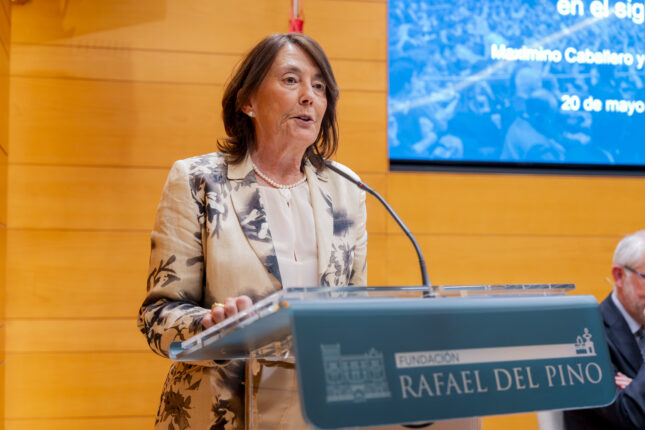
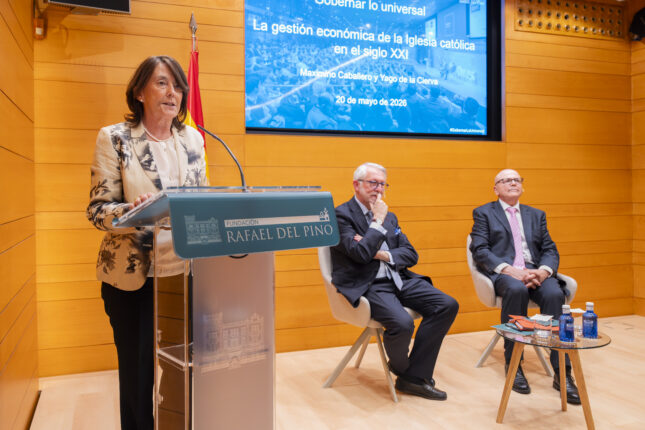
The Rafael del Pino Foundation organised, on 20 May 2026, the dialogue «.«Governing the universal. The economic management of the Catholic Church in the 21st century.»which featured Maximino Caballero in a conversation with Yago de la Cierva.

An exceptional opportunity to understand, from an economic and institutional perspective, how one of the oldest, most universal and unique organisations in the world is managed in the 21st century.

Maximino Caballero Ledo holds a degree in Economics and Business Administration from the Universidad Autónoma de Madrid and an MBA from IESE Business School in Barcelona. He has developed a solid international career in finance and business management. For more than twenty years he worked between Barcelona and Valencia, assuming financial responsibilities for different markets in Europe, the Middle East and Africa. In 2007 he moved to the United States, where he continued his career at Baxter Healthcare Inc. a leading multinational healthcare company based in Deerfield, Illinois. At the company, he held various senior management positions, including Vice President of Finance for Latin America, Vice President of International Finance and Vice President of Finance for the Americas. He also led several strategic projects of global scope. His experience combines financial leadership, international management and strategic direction in highly complex, multicultural environments.

Yago de la Cierva Álvarez de Sotomayor is president of the Villanueva Foundation, the entity that owns Villanueva University, and a specialist in corporate communication, crisis management and institutional communication. He holds a degree in Law, a PhD in Philosophy from the University of Navarra and a Masters in Institutional Communication from the Pontificia Università della Santa Croce (Italy), and has developed his professional career between journalism, university teaching and strategic consultancy. For more than twelve years he taught Corporate Communications and Crisis Management at IESE Business School. In addition, he founded and directed the international television news agency ROMEreports and was executive director of World Youth Day Madrid 2011. He is the author of several books on leadership, reputation and crisis management, both in the corporate sphere and in educational and ecclesiastical institutions, establishing himself as an international reference in strategic and institutional communication.
Summary:

On 20 May 2026, the Rafael del Pino Foundation hosted the dialogue «Governing the universal. The economic management of the Catholic Church in the 21st century», led by Maximino Caballero, Prefect of the Secretariat for the Economy of the Holy See, in conversation with the journalist and expert in institutional communication Yago de la Cierva.

The meeting provided an economic and institutional perspective on one of the most complex and unique governance systems in the contemporary world: the financial administration of the Catholic Church and the Holy See.

In the course of the conversation, Caballero addressed questions related to the Vatican's economic structure, asset management, financial sustainability, institutional transparency and the reform process undertaken in recent years.

Understanding the complex economic architecture of the Church

One of the first issues discussed during the colloquium was the distinction between the Holy See, the Vatican City State and the universal Church, concepts that are often confused in public debate.

Caballero explained that the Holy See constitutes the central governing body of the Catholic Church, while the Vatican State provides the territorial and administrative structure that sustains it. The universal Church, on the other hand, comprises dioceses, parishes and episcopal conferences throughout the world. Financially, the three realities operate independently and with separate accounts.

The prefect also underlined that the Secretariat for the Economy only has competence over the finances of the Holy See and not over the finances of dioceses or bishops' conferences.

A global institution with limited resources

During the dialogue it became clear that the financial dimension of the Holy See is much smaller than is often imagined. According to Caballero, the regular budget of the institution is less than 400 million euros per year, excluding the large hospitals linked to the Vatican. Approximately half of the expenditure is for personnel.

The prefect defended that the economic logic of the Holy See cannot be understood under strictly business criteria, since its purpose is not to maximise profits, but to sustain the universal mission of the Church: evangelisation, diplomatic action, global communication of the pontificate and support for churches in need.

“The more we can spend on the mission, the better; the problem is to spend without wasting,” he said during the conversation.

Professionalisation and heritage management

Another major focus of the meeting was the modernisation of the Vatican's asset management. Caballero explained that between 75% and 80% of the Holy See's income comes from the return on its financial and real estate assets.

In this respect, he highlighted the professionalisation process developed over the last few years, especially in the administration of thousands of real estate assets, mainly in Rome. According to him, all properties that can be economically exploited are currently rented out.

However, he recalled that a very significant part of the heritage cannot be used to generate economic profitability because of its historical or institutional character. Some emblematic assets, such as St. Peter's Basilica, are symbolically listed on the balance sheet for one euro.

Transparency and economic reform

The conversation devoted special attention to the process of economic reform that has taken place in recent decades, particularly under the pontificate of Pope Francis.

Caballero acknowledged that the financial scandals suffered by the Holy See highlighted the need for modern governance, oversight and control mechanisms. In contrast to a traditional culture based on personal trust and secrecy, the new strategy seeks to align with international standards of transparency.

In this context, he defended the publication of the accounts and budgets of the Holy See as a fundamental element to reinforce institutional credibility and guarantee the future sustainability of the Church's mission.

“Transparency is necessary for credibility and credibility is necessary for sustainability,” he summarised.

The role of donations and the geography of generosity

The colloquium also provided an opportunity to find out how the Holy See's activities are financed beyond the financial return on its assets.

Caballero explained that donations from the faithful, channelled mainly through the St. Peter's Obligation, and contributions from dioceses are an essential source of income. The United States, Italy, Germany, South Korea and Spain are among the main contributors.

He also highlighted the recent effort made by the Spanish Episcopal Conference, which has placed Spain among the countries with the highest contribution to the finances of the Holy See.

Continuity in the reform under Leo XIV

In the final part of the meeting, Yago de la Cierva asked Caballero about the role played by both Pope Francis and Pope Leo XIV in the economic transformation of the Holy See.

The prefect attributed to Francis a firm will to eliminate historical privileges and to professionalise Vatican economic management. On Leo XIV, he noted that the new pontiff has given him a clear message: “We cannot turn back” on the path of reform.

According to Caballero, the new Pope remains committed to the economic and institutional modernisation of the Holy See, albeit with a more structured and reflective style of leadership.

A debate on global governance and institutions

With this meeting, the Rafael del Pino Foundation once again placed issues related to the governance of global institutions, organisational sustainability and the adaptation of historical structures to the demands of the 21st century at the centre of the debate.

The conversation between Maximino Caballero and Yago de la Cierva offered a unique insight into the inner workings of the Holy See and the economic, cultural and organisational challenges currently facing one of the world's oldest and most universal institutions.

The Rafael del Pino Foundation is not responsible for the comments, opinions or statements made by the people who participate in its activities and which are expressed as a result of their inalienable right to freedom of expression and under their sole responsibility. The contents included in the summary of this conference are the result of the debates held at the meeting held for this purpose at the Foundation and are the responsibility of their authors.

The Rafael del Pino Foundation is not responsible for any comments, opinions or statements made by third parties. In this respect, the FRP is not obliged to monitor the views expressed by such third parties who participate in its activities and which are expressed as a result of their inalienable right to freedom of expression and under their own responsibility. The contents included in the summary of this conference are the result of the discussions that took place during the conference organised for this purpose at the Foundation and are the sole responsibility of its authors.