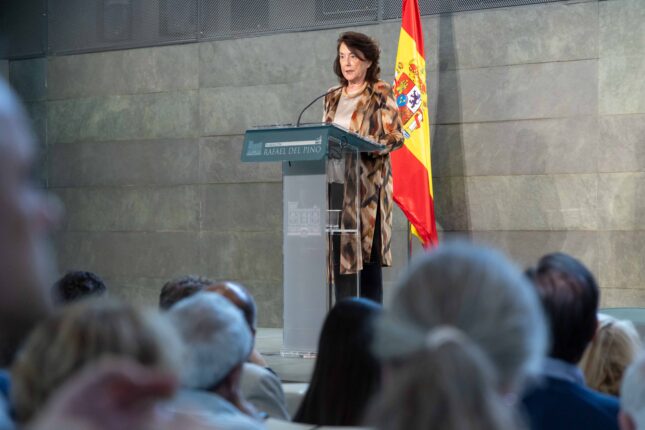
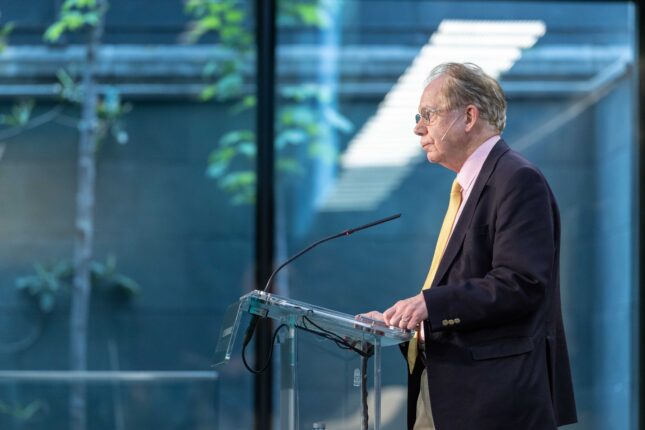
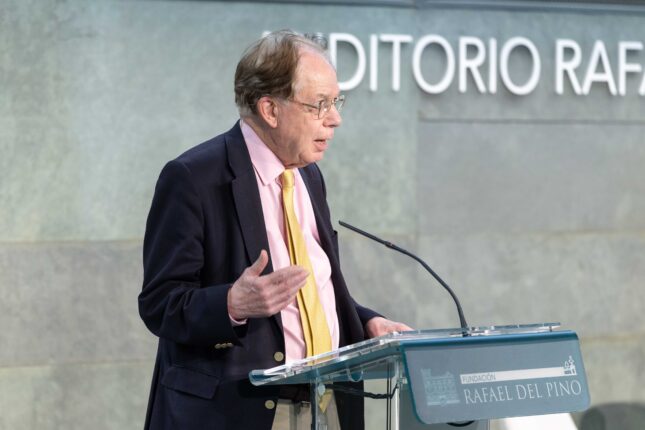
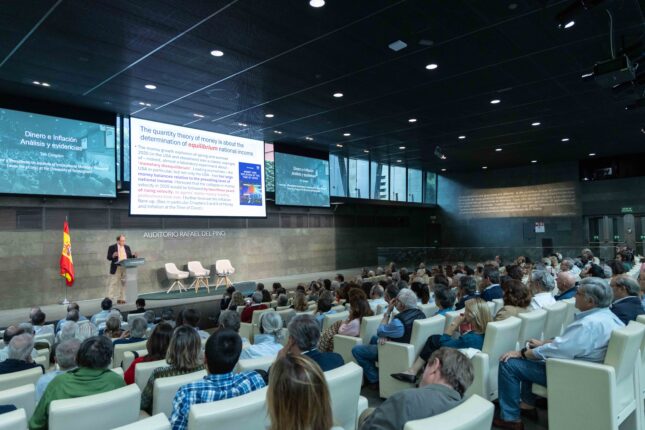
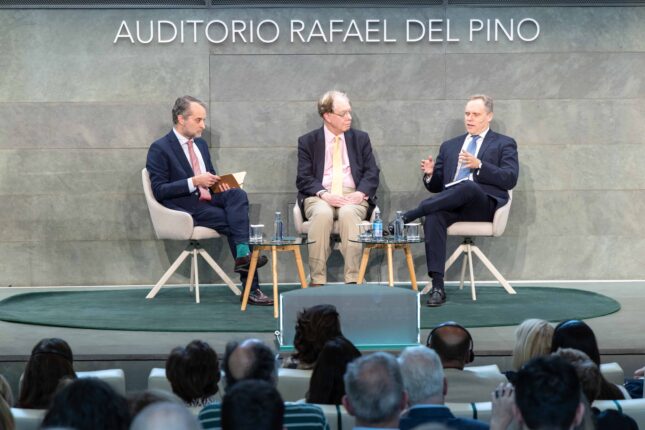
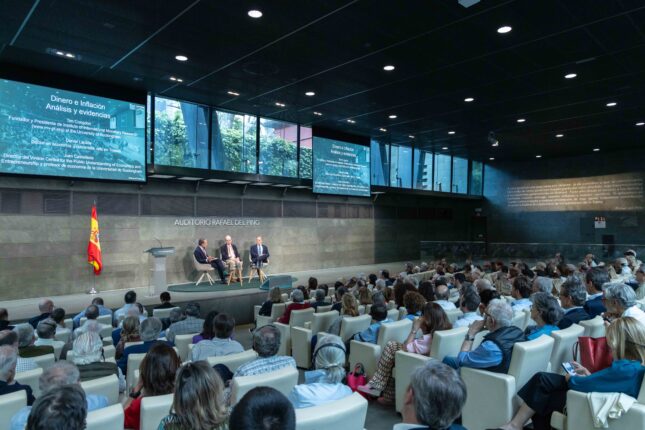
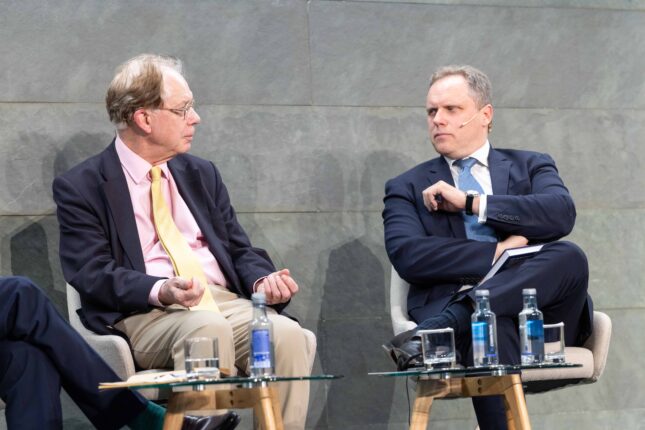
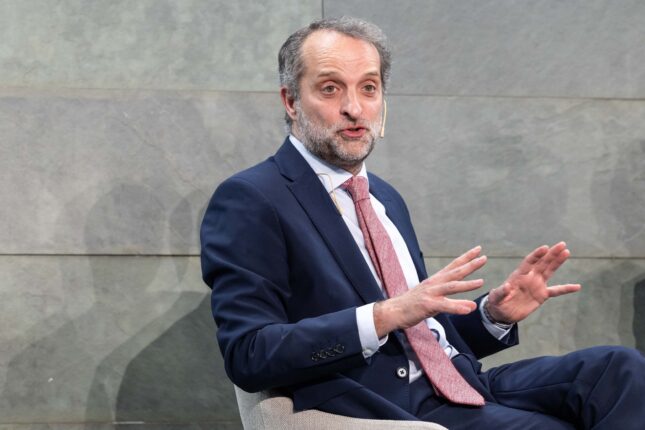
On 20 April, the Foundation organised the Keynote Lecture «Money and Inflation. Analysis and evidence» given by Tim Congdon on the occasion of the presentation of the book «Money and Inflation at the Time of Covid». After the conference he spoke with Daniel Lacalle and Juan Castañeda.
Tim Congdon is one of the world's leading international monetary analysts and a leading figure in contemporary monetarism. He advised the UK government between 1979 and 1997 and was a member of the Treasury Panel (Wise Men) between 1992 and 1997. Founder of Lombard Street Research, he anticipated the inflationary risks arising from excessive monetary growth in the late 1980s. He has done extensive intellectual work in the field of monetary theory and policy and is the author of several seminal works. He is a founder and principal trustee of the Institute of International Monetary Research, of which he was the first director.
Daniel Lacalle D. in Economics, Chief Economist at Tressis S.V., professor of Global Economics at IE and IEB and investment fund manager. He holds a degree in Business Administration from the Universidad Autónoma de Madrid and a PhD Cum Laude from the Universidad Católica de Valencia. He is Chairman of the Instituto Mises Hispano, member of the Advisory Board of the Rafael del Pino Foundation and of ORFIN. He is also a member of the Academic Council of the International Freedom Foundation (FIL). His career in portfolio management and investment began at the hedge fund Citadel and continued at Ecofin Ltd. and PIMCO in the US and London. He is ranked number 5 in the Richtopia 2020 ranking of the world's most influential economists. He has been voted for five consecutive years among the top three managers in the Extel Survey, the Thompson Reuters ranking in the general strategy, oil and power categories. He writes a weekly column in El Español, and contributes monthly to CNBC and Bloomberg TV, as well as Antena 3, Cuatro, Telecinco, BBN Times, World Economic Forum, Hedge Eye, Epoch Times and Mises Wire, among others. Daniel Lacalle is the author of books on economics translated into several languages, including: "Nosotros los mercados", "Viaje a la libertad económica", "La gran trampa", "Libertad o Igualdad", and the latest, "Haz crecer tu dinero" (Deusto, 2022).
Juan Castañeda is Director of the Vinson Centre for the Public Understanding of Economics and Entrepreneurship and Professor of Economics at the University of Buckingham since 2012. D. in Economics since 2003 (UAM), Juan Castañeda has focused his academic and research activity on monetary policy and central banking. Juan was Director of the Institute of International Monetary Research from 2016 to 2023. He has collaborated with the Bank of Spain, the Committee on Economic and Monetary Affairs of the European Parliament and the British Parliament. He has been Honorary Senior Visiting Fellow at Cass Business School (London) and visiting fellow at the Centre for Monetary and Financial Alternatives of the Cato Institute (Washington DC), and at the Universidad Francisco Marroquín in Guatemala. Before moving to the UK, he was a lecturer at UNED. He is the associate editor of the journal 'Economic Affairs' and author of academic books and research articles on money, monetary policy and central banking in historical perspective. He is a member of the Academic Advisory Committee and the Shadow Monetary Policy Committee of the Institute of Economic Affairs (London).
Summary:
On 20 April, the Rafael del Pino Foundation organised the Keynote Lecture “Money and Inflation. Analysis and evidence”, given by the British economist Tim Congdon on the occasion of the presentation of his book Money and Inflation at the Time of Covid. In his speech, Congdon defended a monetary interpretation of the post-pandemic inflationary surge, arguing that the sharp increase in the quantity of money made it possible to anticipate a scenario that, in his view, most of the economics profession failed to foresee.
A frontal critique of the macroeconomic consensus
From the outset of his lecture, Congdon put forward a compelling thesis: during the early stages of the 2020 health crisis, a substantial part of the economic and financial establishment anticipated several years of disinflation or even deflation. Yet just two years later, advanced economies were recording their highest inflation rates in four decades.
Faced with this misdiagnosis, the British economist claimed to have anticipated, together with Juan Castañeda, an inflationary episode from March and April 2020. From there, he articulated a severe critique of the dominant models of macroeconomic forecasting and the role played by economists and international institutions during that period.
The amount of money as a decisive variable
The core of the intervention revolved around his own version of the quantity theory of money. Congdon argued that in order to understand nominal income and price developments, it is necessary to look first and foremost at two variables: the quantity of money - broadly understood, especially as bank deposits - and the demand for money by households and investors.
He explained that the pandemic led to extraordinary growth in monetary aggregates, particularly in the United States, but also in the euro area, the United Kingdom and other advanced economies. This increase, he argued, was of a magnitude incompatible with a prolonged scenario of price stability.
From pandemic shock to inflationary resurgence
One of the central aspects of the conference was the reconstruction of the mechanism that, in his view, led from the health shock to the subsequent inflationary surge. Initially, the increase in liquidity coincided with a fall in the velocity of money, in an environment of uncertainty and contraction in activity. But this situation could not continue indefinitely.
As consumption, investment and mobility normalised, the velocity of money began to recover. If that recovery occurred, moreover, on an extraordinarily expanded monetary base, the result had to be, in his analysis, a sustained rise in inflation. It was precisely this sequence that Congdon claimed to have anticipated.
Asset markets and excess money
The conference was not limited to the behaviour of consumer prices. Congdon also argued that monetary expansion explained the strength seen in asset markets in 2020 and 2021, despite the global health crisis. In his view, the evolution of housing, stock markets and other assets could not be understood without taking into account the surplus of money accumulated in the system.
This approach served to reinforce an underlying idea: a macroeconomics that focuses almost exclusively on interest rates is insufficient to correctly interpret episodes of this nature. In his view, the monitoring of monetary aggregates remains indispensable.
A challenge to the interest-rate-only approach
Congdon devoted a significant part of his presentation to questioning what he called an “interest rate only” macroeconomics. He argued that much of the mistake made by the profession can be explained by relegating money to a secondary role and relying on analytical frameworks that almost exclusively prioritise the official interest rate and the yield curve.
Against this, he argued for a “broad money monetarism” approach, in which bank deposits, credit expansion and the asset structure of the financial system play a central role. He also stressed the importance of bank capital in understanding the expansion capacity of the financial system, an element that, he said, has been insufficiently incorporated in certain theoretical approaches.
Central banks, inflation and credibility
In the final part of his speech, Congdon questioned explanations that attributed the inflationary spike exclusively to cost shocks or to supervening external factors, such as the war in Ukraine. Without denying the relevance of these elements, he argued that the root of the problem was monetary and that central banks should have understood earlier the consequences of the extraordinary monetary expansion since 2020.
From that perspective, he warned that the credibility of monetary authorities could be eroded if the source of imbalances was not properly recognised. Even so, he reiterated his support for central bank independence, while insisting that price stability requires keeping money growth in line with growth in the production of goods and services.
A defence of monetary and fiscal stability
In closing, the British economist linked macroeconomic stability to two basic conditions: a stable evolution of the quantity of money and balanced public finances. In his view, controlling inflation depends not only on the ex post reaction of central banks, but also on avoiding disorderly monetary expansions and preserving budgetary discipline.
The conference held at the Rafael del Pino Foundation thus offered an articulate defence of the monetarist approach in a context of a critical review of the dominant analytical frameworks. Beyond the academic debate, the session raised a fundamental question for economists, policymakers and investors: to what extent monetary aggregates continue to be an essential tool for interpreting contemporary inflationary dynamics.
The Rafael del Pino Foundation is not responsible for the comments, opinions or statements made by the people who participate in its activities and which are expressed as a result of their inalienable right to freedom of expression and under their sole responsibility. The contents included in the summary of this conference are the result of the debates held at the meeting held for this purpose at the Foundation and are the responsibility of their authors.
The Rafael del Pino Foundation is not responsible for any comments, opinions or statements made by third parties. In this respect, the FRP is not obliged to monitor the views expressed by such third parties who participate in its activities and which are expressed as a result of their inalienable right to freedom of expression and under their own responsibility. The contents included in the summary of this conference are the result of the discussions that took place during the conference organised for this purpose at the Foundation and are the sole responsibility of its authors.