The Spanish economy in the last millennium: progress, decline and efficiency
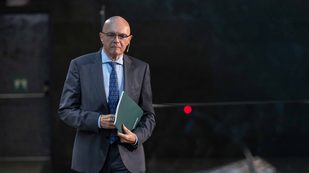
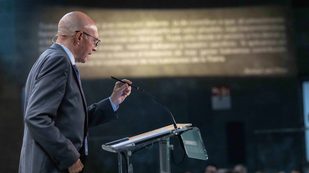
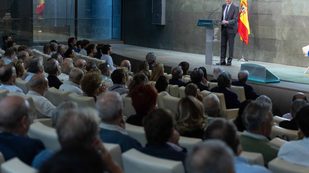
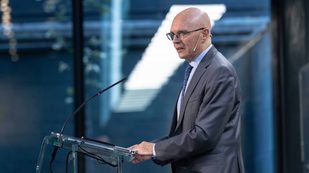
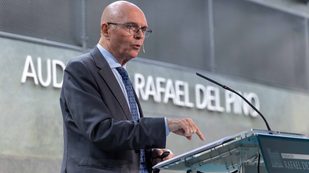
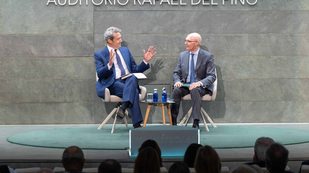
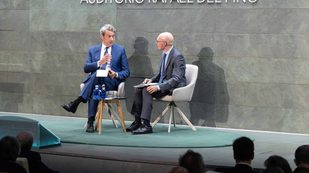
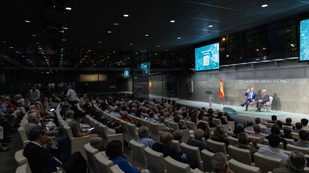
On 29 September 2026, the Rafael del Pino Foundation organised the Keynote Lecture on Leandro Prados de la Escosura entitled "The Spanish economy in the last millennium: progress, decline and efficiency». Following the lecture, Professor Prados de la Escosura spoke with Vicente J. Montes Gan, Director of the Rafael del Pino Foundation.
Leandro Prados de la Escosura, Professor Emeritus of Economic History at Carlos III University in Madrid and a Research Fellow at the Centre for Economic Policy Research in the United Kingdom, is also the Rafael del Pino Professor. He holds a PhD from the University of Oxford and a PhD in Economics from the Complutense University of Madrid, and has taught at Georgetown University (as the Prince of Asturias Chair) and the University of California, San Diego. He has held the Maddison Honorary Chair at the University of Groningen and has been a Leverhulme Professorial Fellow at the London School of Economics and Political Science (LSE), a Visiting Fellow at All Souls College, Oxford, and a Jean Monnet Fellow at the European University Institute (Florence).
Editor of the *Economic History Review* and a member of the editorial board of several international academic journals. He has served as president of the European Historical Economics Society and as a member of the Executive Committee of the International Economic History Association. He is a corresponding member of the Academia das Ciências de Lisboa and the Real Academia de la Historia. His most recent books include Economic Growth in Spain, 1850–2015 (Palgrave Macmillan, 2017), Human Development and the Path to Freedom (Cambridge University Press, 2022) and A Millennial View of Spain’s Development: Essays in Economic History (Springer, 2024). He is currently conducting research into economic freedom and global well-being from a historical perspective, and into Spain’s economic development over the very long term.
Summary:
On 29 September 2026, the Rafael del Pino Foundation organised the keynote lecture «The Spanish economy in the last millennium: progress, decline and efficiency», delivered by Leandro Prados de la Escosura, Professor Emeritus of Economic History at Carlos III University in Madrid, researcher at the Centre for Economic Policy Research and holder of the Rafael del Pino Chair.
A long-term view of the Spanish economy
Leandro Prados de la Escosura proposed taking a journey through more than seven centuries of economic history to analyse how far Spain has progressed, at what points there have been advances and setbacks, and, above all, what role efficiency has played in that development.
In contrast to an interpretation of economic history that sets a long period of stagnation prior to the Industrial Revolution against the subsequent growth, Prados de la Escosura demonstrated that the evolution was far more complex. Before the 19th century, there were prolonged periods of growth in per capita income, followed, in turn, by periods of decline.
From an international perspective, Spain is, as he explained, a relatively successful case, albeit one that has not been sustained. It currently forms part of the group of high-income economies, but remains a significant distance behind the most advanced Western countries. To understand how it has reached this position, he highlighted three major historical milestones: the Black Death, Spain’s decline in the Early Modern period and industrialisation.
Efficiency: a key factor
One of the central themes of the conference was the importance of distinguishing between growth achieved by bringing in more resources and growth achieved by using them more effectively. According to Prados de la Escosura, differences in efficiency — known as total factor productivity — help to explain a key aspect of the Spanish economy’s development and its relative position compared with other countries.
Their analysis showed that, historically, when Spanish productivity rose, it was often due to a greater use of resources per worker. However, when comparing Spain with the economies that went on to take the lead internationally, the differences were largely related to the efficiency with which those resources were utilised.
He also highlighted a link between efficiency, growth and income distribution: periods of increased efficiency have historically coincided with higher levels of prosperity and a more equitable distribution of income, whilst periods of declining efficiency have been associated with lower growth and greater inequality.
From the Black Death to the Decline of Spain
The first major event analysed was the Black Death. Its impact on the Spanish economy differed from that seen in other parts of Europe. In some regions, the sharp decline in population led to labour shortages, drove up wages and encouraged innovations aimed at replacing labour with capital.
In Spain, however, the abundance of land and the previous scarcity of population had shaped a frontier economy. The population decline disrupted that balance and contributed to a less favourable trend in per capita income. The plague, therefore, did not have the same economic effects across all European societies.
Prados de la Escosura also addressed the decline of the Spanish economy during the Early Modern Period. Among the factors analysed, he highlighted de-urbanisation and de-industrialisation, as well as the impact of wars and the monarchy’s financing needs. The rise in the tax burden and monetary instability contributed to a reduction in economic activity and in the incentives to increase productivity.
The great change of the 19th century
The Napoleonic Wars marked another significant turning point. Although they took a heavy human and economic toll in the short term, they were followed by far-reaching institutional changes.
The liberal revolution led to a redefinition of property rights, equality of citizens before the law, the liberalisation of markets and greater parliamentary control over public revenue and expenditure. From that point onwards, the Spanish economy underwent a fundamental change.
Prados de la Escosura thus contrasted the Spain of the subjects, characterised by recurrent episodes of growth and contraction, with the Spain for its citizens, during which living standards have risen steadily, albeit with exceptions such as the Civil War, the post-war period and the era of autarky, and with growth that has been less robust than that recorded by other advanced economies.
The current challenge of productivity
The historical perspective made it possible to link the analysis to one of the main challenges currently facing the Spanish economy. Prados de la Escosura pointed out that the process of convergence with the most advanced economies was particularly intense during the final decades of the 20th century, but subsequently lost momentum.
Since the late 1980s, efficiency has ceased to play the leading role it did in earlier periods. Growth has relied to a greater extent on the accumulation of physical capital and, to a lesser extent, on human capital. Among the possible explanations, he cited low investment in intangible assets and in R&D, the limited adoption of new technologies, barriers to competition, and certain regulatory, administrative and judicial inefficiencies.
During his discussion with Vicente J. Montes Gan, Prados de la Escosura explored this analysis in greater depth. He pointed out that progress in improving the composition of capital has stagnated since the 1990s and that human capital has also shown little progress for decades. These trends run parallel to the poor performance in terms of efficiency.
Technology and artificial intelligence
The discussion finally turned to the potential of new technologies to transform productivity. Prados de la Escosura pointed out that major innovations such as the railway and electrification have historically been linked to periods of increased efficiency.
In this context, he described artificial intelligence as one of the major innovations capable of bringing about far-reaching economic transformations. Its spread, he noted, could be considerably faster than that of previous technologies such as steam or electricity. From a historical perspective, he expressed an optimistic view of technological progress’s capacity to raise living standards in the long term, although he cautioned that its initial effects on income distribution may vary.
The conference concluded by highlighting the scope Spain still has to improve its relative position. The experience of the last seven centuries shows that economic progress does not depend solely on having more capital or more resources, but on use them more efficiently. An issue that links Spain’s economic history to one of its main challenges for the future.
The Rafael del Pino Foundation is not responsible for the comments, opinions or statements made by the people who participate in its activities and which are expressed as a result of their inalienable right to freedom of expression and under their sole responsibility. The contents included in the summary of this conference are the result of the debates held at the meeting held for this purpose at the Foundation and are the responsibility of their authors.
The Rafael del Pino Foundation is not responsible for any comments, opinions or statements made by third parties. In this respect, the FRP is not obliged to monitor the views expressed by such third parties who participate in its activities and which are expressed as a result of their inalienable right to freedom of expression and under their own responsibility. The contents included in the summary of this conference are the result of the discussions that took place during the conference organised for this purpose at the Foundation and are the sole responsibility of its authors.