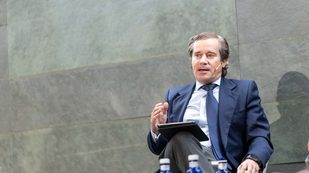
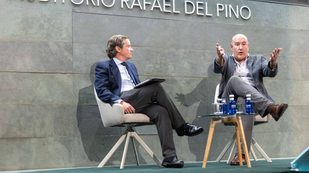
On 20 October 2026, the Rafael del Pino Foundation organised the keynote lecture “The Future of Digital Money», which was delivered by Mauro Guillén. Following the conference, Professor Guillén spoke with Luis Maldonado.
Mauro F. Guillén William H. Wurster Professor of Multinational Management and Vice-Dean of the MBA Program for Executives in the Wharton School from the University of Pennsylvania and a recognised expert on global trends, international markets and economic transformation. Trained in sociology at Yale and in business economics in Spain, his work combines quantitative analysis and an interdisciplinary approach to identify the major opportunities and challenges that arise at the intersection of demographics, technological innovation and financial evolution.Author of the bestseller 2030: How Today's Biggest Trends Will Collide and Reshape the Future of Everything -selected as Book of the Year by the Financial Times-He has received prestigious academic distinctions such as Fulbright, Rockefeller and Guggenheim fellowships. His research and ideas have been reported in media such as The New York Times, The Economist o Financial Times, and has been appointed Knight of the Order of Civil Merit by H.M. King Felipe VI.
Luis Maldonado He is a Commercial Technician and State Economist, with over 25 years’ experience in finance within the public sector, banking and international financial organisations. He is currently a consultant specialising in digital financial services and sustainable finance, and works with, amongst other organisations, the International Finance Corporation (IFC) and the World Bank. He is also a lecturer at IE University and a co-founder and adviser to several technology companies. He has served on various boards of directors and advisory boards. Until May 2026, he was a senior adviser and director at Beka Finance. Throughout his career, he has held senior management positions in both the public and private sectors. He has served as an adviser to the Deputy Prime Minister and Minister for the Economy; as Director of Strategic Consulting at PwC; as Director of Strategy and Corporate Development and a member of the Management Committee at Bankia (now CaixaBank); as Managing Director of the Financial Sector Centre at PwC and IE Business School; and as a senior adviser at Everis (now NTT Data). He has extensive international experience. For five years he worked at the International Monetary Fund (IMF) in Washington D.C., where he served as an adviser to the Managing Director and also as an adviser in the Capital Markets Department. He has also served as a consultant to the Inter-American Development Bank (IDB) and as an investment expert at UNWTO. He holds a PhD in Economics (cum laude) from the University of Alcalá and a degree in Law and in Economics and Business Studies from the Pontifical University of Comillas (ICADE E-3). He also holds a certificate in Business Administration from Georgetown University and completed a Global Senior Management Programme at the University of Chicago (Booth School of Business) and IE Business School.
On 20 October 2026, the Rafael del Pino Foundation organised the keynote lecture «The Future of Digital Money», delivered by Mauro Guillén. Following his presentation, Professor Guillén spoke with Luis Maldonado about the economic, political and social implications of the transformation of money and payment systems.
Trust as the foundation of money
Trust was the starting point for the conference. Guillén explained that the acceptance of a currency depends on the credibility of the issuer and on the shared expectation that other people will also use it. From this perspective, he framed the development of digital money within a debate that goes beyond technology: who controls the money, what safeguards it offers, and how it might alter the relationships between citizens, businesses and states.
The professor distinguished between decentralised cryptocurrencies, such as Bitcoin, stablecoins and digital currencies issued by central banks. These alternatives are based on different models of issuance, management and backing, and so their opportunities and risks require specific analysis.
Bitcoin: limited supply and volatility
A central part of his speech was devoted to how Bitcoin works. Guillén pointed out that its supply follows predetermined rules that limit issuance and make it difficult for it to adapt to changes in economic conditions. As he explained, this rigidity means that fluctuations in demand and market participants’ expectations play a decisive role in its price. The predictability of the supply, therefore, does not equate to price stability.
It also examined the feedback mechanisms that can amplify these fluctuations. When holders expect prices to rise, they have an incentive to hold on to their bitcoins; when they anticipate a fall, they may rush to sell. These dynamics help to explain the asset’s volatility and the difficulties in using it as a means of payment in everyday life.
The risks of investing in crypto-assets
With regard to investment, Guillén emphasised that it is not enough simply to compare the purchase price and the sale price: the performance between those two points is also important. Interim losses may force an investor with debt to provide additional collateral or lead them to sell before a recovery takes place.
He also questioned whether bitcoin should automatically be regarded as a hedge against inflation and argued that it is necessary to assess its risk, its return and the available alternatives before including it in a portfolio. In his analysis, he emphasised that its low correlation with other assets is not, in itself, sufficient to justify an investment if there are alternatives that can fulfil a similar role within a diversified portfolio.
Stablecoins: backing and supervision
Stablecoins raised another key issue: the quality of their backing. Guillén emphasised the importance of verifying that issuers’ reserves correspond to the commitments they have undertaken. In this regard, he insisted that regulation must be accompanied by effective supervision to help maintain confidence and reduce risks to the financial system.
During the discussion, Luis Maldonado highlighted the risks of contagion between digital assets and the development of alternative channels for international payments. The two also examined the possibility that the expansion of dollar-pegged stablecoins might reinforce the US dollar’s presence in the global economy.
Central bank digital currencies
The conference also addressed the reasons driving central banks to explore digital versions of their currencies. Among these, Guillén mentioned the decline in the use of cash, competition from new private solutions, the defence of monetary sovereignty and the potential to broaden access to financial services.
He warned, however, that its design raises questions about privacy, cybersecurity, monetary policy and the role of commercial banks. The possibility of altering the relationship between citizens and central banks necessitates an examination of its effects on deposits, financial intermediation and the balance between the various players in the system.
The geopolitical dimension of digital currency
Guillén linked monetary innovation to the competition between the United States, China and Europe for financial leadership and control of payment infrastructures. In this context, he explained that digital money could become a tool for reducing dependencies and expanding international influence, although technology alone does not solve the challenge of building trust in a currency.
In the case of China, he analysed the country’s interest in expanding the international use of its currency and reducing its dependence on the dollar. With regard to Europe, he highlighted the aspiration to achieve greater autonomy in payment systems. The development of new currencies and financial infrastructures is thus part of a competitive landscape that affects both the economy and international relations.
Privacy, security and the power of institutions
The discussion delved into the balance between privacy, security and the prevention of illegal activities. The participants examined how certain forms of digital currency could expand the authorities’ ability to monitor citizens’ transactions.
Guillén pointed out that this potential concentration of information and power raises important issues for democracies and requires consideration of the institutional consequences of the design of these systems. He also emphasised that technological security is an essential prerequisite for their acceptance: vulnerabilities and theft can undermine trust in solutions that seek to consolidate their legitimacy.
The future of the digital euro and smart contracts
On the future of the digital euro, Maldonado predicted a gradual roll-out, with trials and applications amongst financial institutions before any potential widespread use by the public. In his view, the complexity of its implementation and its implications for banking intermediation call for caution regarding the timeframe.
Finally, the meeting addressed the potential of smart contracts to automate operations and reduce costs. Guillén highlighted their potential, but pointed out that greater speed and efficiency can also have consequences that are difficult to anticipate. Their development therefore requires an examination of both the technological opportunities and their economic, legal and institutional implications.
The Rafael del Pino Foundation is not responsible for the comments, opinions or statements made by the people who participate in its activities and which are expressed as a result of their inalienable right to freedom of expression and under their sole responsibility. The contents included in the summary of this conference are the result of the debates held at the meeting held for this purpose at the Foundation and are the responsibility of their authors.
The Rafael del Pino Foundation is not responsible for any comments, opinions or statements made by third parties. In this respect, the FRP is not obliged to monitor the views expressed by such third parties who participate in its activities and which are expressed as a result of their inalienable right to freedom of expression and under their own responsibility. The contents included in the summary of this conference are the result of the discussions that took place during the conference organised for this purpose at the Foundation and are the sole responsibility of its authors.