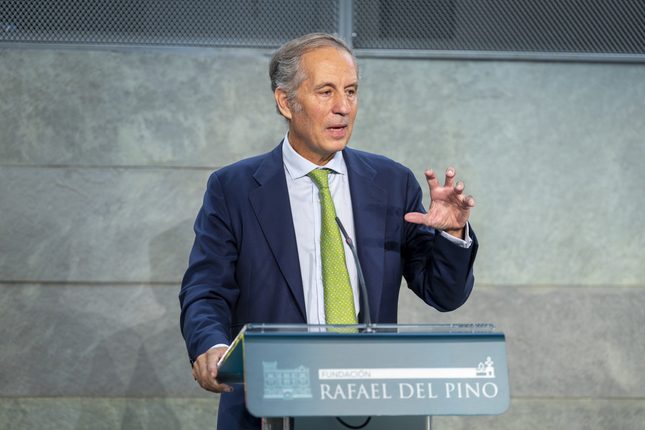
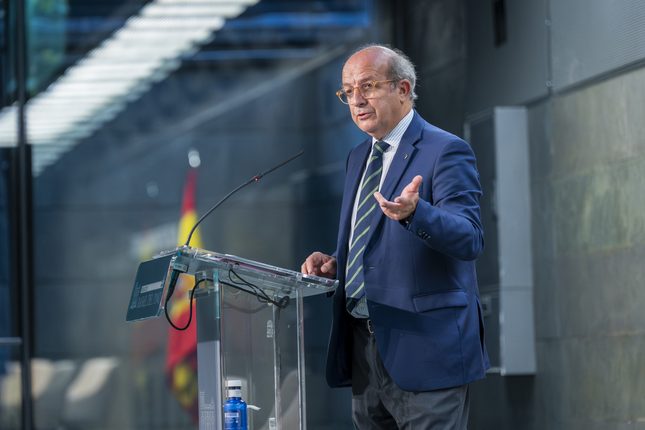
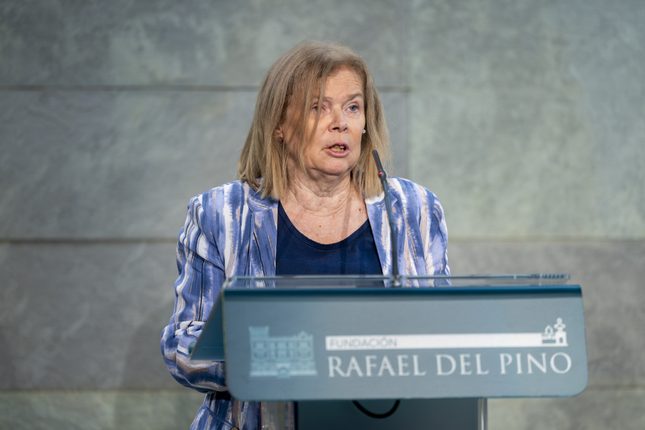
Elisa de la Nuez, Daniel Calleja and Juan Mora Sanguinetti
The Rafael del Pino Foundation and the Hay Derecho Foundation organised, the 6 October 2026, the presentation of the Rule of Law Report 2026.
The meeting was opened by Maria del Pino, Chair of the Rafael del Pino Foundation, and Segismundo Álvarez, president of the Hay Derecho Foundation.
Next, Daniel Calleja and Crespo, Head of the European Commission’s Representation in Spain, will address the Challenges to the rule of law in the European Union.
Subsequently, Elisa de la Nuez, the report’s director, a government lawyer on secondment and Secretary-General of the Hay Derecho Foundation, will present its main findings and conclusions.
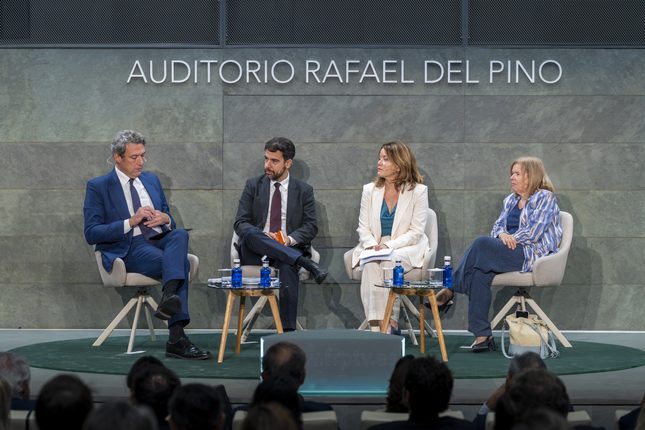
Following the presentation, a discussion took place in which the following people took part:
Elisa de la Nuez, director of the 2026 Rule of Law Report and secretary-general of the Hay Derecho Foundation.
Juan Mora Sanguinetti, Professor of Economics at Cardenal Herrera-CEU University, Valencia.
Natalia Velilla, judge and writer.
The discussion was moderated by Vicente J. Montes Gan, Director of the Rafael del Pino Foundation.
The Rule of Law Report 2026 This is a study based on objective data that analyses the evolution of institutional and democratic quality in Spain. It examines the independence and capacity of the judiciary and the Public Prosecutor’s Office; the work of the Spanish Parliament; the functioning of the main institutional checks and balances; the protection of fundamental rights and legal certainty; the quality of legislation; transparency, public integrity and the fight against corruption; as well as media freedom and pluralism. Its aim is to provide a comprehensive, exhaustive and rigorous assessment of the strengths and weaknesses of the Spanish institutional system and to contribute to an informed debate on the necessary improvements. It is the most comprehensive analysis currently available on the rule of law in Spain, which the Hay Derecho Foundation makes available to institutions and society.
Summary:
The Rafael del Pino Foundation and the Hay Derecho Foundation On 6 October 2026, they organised the launch of the Report on the Rule of Law 2026, a study which analyses, on the basis of objective data and national and international indicators, the current state and development of the main institutions and checks and balances within the Spanish democratic system.
The event began with a talk on the Challenges to the rule of law in the European Union. The report’s main findings and conclusions were then presented, followed by a discussion on institutional quality, legal certainty, the functioning of the justice system, and its economic and social implications.
The rule of law, an essential element of the European project
Daniel Calleja and Crespo, Head of the European Commission’s Representation in Spain, described the rule of law as the cornerstone of European integration. He pointed out that the European Union has developed over seven decades through a gradual process of integration based on common rules and trust in their observance.
In an international context characterised by significant geopolitical, security and competitiveness challenges, Calleja pointed out that Europe must remain true to its founding values. In this regard, he stated that the rule of law is of «existential» importance to the European Union: its strength lies in the rules that Member States freely agree upon together and in the confidence that these will be respected and applied equally.
He explained the six pillars on which the European Commission bases its understanding of the rule of law: legality, legal certainty, prohibition of arbitrary exercise of power by the executive, effective judicial protection, separation of powers and equality before the law.
Calleja also outlined the tools available to the European Union for preventing and responding to potential breaches. Among these, he highlighted the European Commission Annual Report on the Rule of Law, the recommendations addressed to Member States, infringement proceedings and the mechanisms that make the disbursement of certain European funds conditional upon compliance with these principles.
With regard to Spain, he recalled the renewal of the General Council of the Judiciary in 2024 and pointed out that progress still needs to be made on reforming the system for the appointment of judges in line with European standards.
He also indicated that future enlargement processes of the Union will incorporate greater safeguards against possible institutional setbacks once accession has taken place.
The main conclusions of the 2026 Rule of Law Report
Next, Elisa de la Nuez, the report’s director, presented its main findings. The analysis focuses primarily on 2024 and 2025, although it includes some updates for 2026 and historical time series that allow us to observe the trends in certain indicators.
The report partly follows the methodology used by the European Commission, whilst expanding upon it and adapting it to the Spanish context. One of its main features is the use of quantitative data and objective indicators to assess changes in institutional quality.
De la Nuez pointed out that the main international indicators show a trend towards a decline in institutional quality and an erosion of public trust in institutions. He explained that this decline does not primarily affect the electoral aspect of Spanish democracy, but rather, in particular, the quality of the institutional checks and balances and the limits on the exercise of power.
The areas analysed in the report include the The Judiciary and the Public Prosecutor’s Office; the Spanish Parliament; institutional checks and balances; fundamental rights and legal certainty; the drafting of legislation; transparency, integrity and the fight against corruption; and freedom and pluralism of the media.
Among its conclusions were issues relating to the independence and perceived independence of the judiciary, growing institutional polarisation, shortcomings in certain appointment procedures, and the need to strengthen the criteria of merit and competence.
The report also focuses on the quality of legislative output and the increasing use of procedures that reduce some of the usual checks and formalities involved in the drafting of laws. With regard to transparency and institutional integrity, it highlights the need to strengthen preventive mechanisms and improve the functioning of the bodies responsible for ensuring access to public information.
Among its recommendations are the the professionalisation of institutions, the strengthening of their independence, the application of objective criteria based on merit and ability in appointments, the strengthening of checks and balances, and the improvement of mechanisms for preventing corruption and ensuring transparency.
Institutional quality, the economy and legal certainty
Following the presentation of the report, a discussion took place between Elisa de la Nuez, Juan Mora Sanguinetti and Natalia Velilla, moderated by Vicente J. Montes Gan, Director of the Rafael del Pino Foundation.
Juan Mora Sanguinetti He focused part of his speech on the economic consequences of institutional quality and, in particular, on the impact of increasing regulatory complexity.
He highlighted the sharp rise in the volume of legislation in Spain over recent decades: whereas some 4,000 pieces of legislation were enacted annually in the 1980s, around 12,000 are now published each year. This regulatory complexity generates costs for citizens and businesses and particularly affects smaller companies and new entrants to the market.
The existence of clear, predictable and accessible rules is therefore essential to facilitate business activity, competition and investment.
Legal proceedings and political accountability
Natalia Velilla He addressed the functioning of the justice system and the relationship between the various branches of government. In particular, he warned against the tendency to refer disputes to the courts that should instead be resolved at a political or institutional level.
In this regard, he argued that it is necessary to distinguish between criminal liability and political liability. The proper functioning of a democracy cannot reduce public accountability solely to determining whether or not a particular act constitutes a criminal offence.
During the discussion, issues relating to judicial independence, the separation of powers and the need for each institution to carry out its functions within its respective remit were also addressed.
The rule of law and everyday life
Elisa de la Nuez During the discussion, he emphasised that the defence of the rule of law must remain above party politics. Democratic rules and institutional checks and balances must be upheld regardless of who is in power at any given time.
He also emphasised the need to bring these issues closer to the public. Legal certainty, the quality of legislation and the functioning of institutions have a direct impact on everyday matters such as a contract, a tenancy, business activities or the exercise of rights.
Finally, the participants discussed the role of civil society, transparency and access to information as tools for strengthening institutions and tackling polarisation.
The meeting highlighted that the quality of the rule of law is not merely a legal or institutional issue. It also underpins the public confidence, the functioning of the economy, legal certainty and the quality of democracy.
The Rafael del Pino Foundation is not responsible for the comments, opinions or statements made by the people who participate in its activities and which are expressed as a result of their inalienable right to freedom of expression and under their sole responsibility. The contents included in the summary of this conference are the result of the debates held at the meeting held for this purpose at the Foundation and are the responsibility of their authors.
The Rafael del Pino Foundation is not responsible for any comments, opinions or statements made by third parties. In this respect, the FRP is not obliged to monitor the views expressed by such third parties who participate in its activities and which are expressed as a result of their inalienable right to freedom of expression and under their own responsibility. The contents included in the summary of this conference are the result of the discussions that took place during the conference organised for this purpose at the Foundation and are the sole responsibility of its authors.