


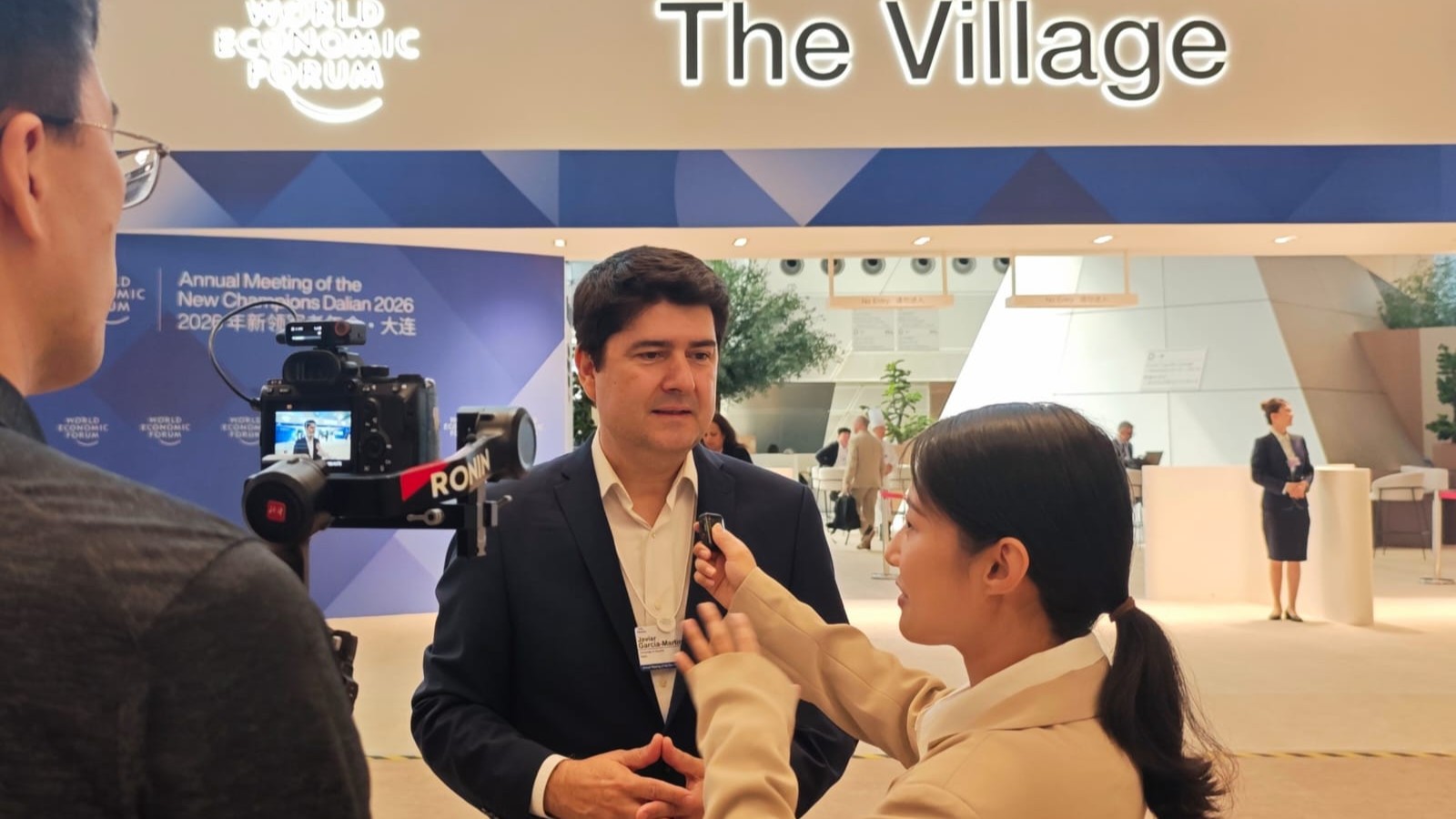
What’s the atmosphere like in Dalian?
Most discussions centre on China’s new five-year plan, which undoubtedly has a very clear priority: to turn its technological edge in certain sectors – such as AI, advanced manufacturing, semiconductors, biotechnology and new energy sources – into drivers of growth and industrial sovereignty.
That is why the main focus here is on scale, which is the key theme of this year’s meeting. For Spain, the message is clear. China is at once a partner, a market and a technological competitor. Bilateral relations are now closer than ever, but they will only be fully beneficial if we are able to collaborate in sectors where there is shared value and strengthen our own capabilities in critical technologies.
Why should you read the report on 10 Emerging Technologies from the World Economic Forum?
Because it focuses on the technologies that can really make a difference. We are surrounded by technology advertisements, but not all innovations are sufficiently mature or capable of transforming the economy. This report identifies ten emerging technologies that are entering a decisive phase, as they are beginning to scale up, are attracting the interest of businesses and investors, and are likely to have a significant impact in the coming years.
This is not a list of the year’s most important discoveries, but a strategic tool. This report helps us to anticipate and identify the workplace skills that will be most important in the coming years, and how we can best respond to major global challenges such as the energy transition, health and digital security. The next wave of technology will be more personalised, distributed and efficient. In other words, technologies that are better tailored to individual needs, closer to where they are used, and capable of achieving more with fewer resources.
Sustainability continues to set the pace in the identification of emerging technologies.
It would be a mistake to view these technologies in isolation. Their impact becomes apparent when they are combined: direct lithium extraction can accelerate the development of the batteries needed for distributed electricity systems; buildings can consume less energy thanks to radiative cooling whilst, at the same time, feeding electricity back into the grid; and the breakdown of PFAS helps to better close the environmental cycle of the chemical industry. Sustainability will not come from a single solution, but from integrating energy, materials and clean chemistry into more efficient and resilient systems.
The report also covers biomedical advances. What message do they convey regarding the transformation of healthcare systems?
Medicine is moving towards a much higher degree of personalisation. Personalised mRNA cancer vaccines aim to train the immune system to target tumour-specific mutations in each patient. The delivery of drugs via exosomes could enable therapies to reach hard-to-reach parts of the body, including the brain. Quantum simulation applied to drug discovery can speed up the identification of promising molecules. The key takeaway is that the convergence of biology, chemistry, computing and artificial intelligence is changing the way we understand health.
And what role are artificial intelligence and digital security playing?
A central role. World models represent a new frontier for artificial intelligence. These are systems capable of building a richer understanding of the physical environment from multiple types of data, which can improve prediction, planning and the interaction of machines with the real world. At the same time, lattice-based cryptography will enable us to protect our digital infrastructure against current computers as well as future quantum computers.
If we combine the report with what is happening in the corridors and on the stages in Dalian, what conclusions should we draw?
That the competitive advantage of the future will depend less on natural resources and more on scientific, industrial, regulatory, educational and deployment capabilities. Technology alone does not bring about change. Infrastructure, talent, investment, smart regulation, public trust and a long-term vision are all required. Another important lesson is that many of these technologies lie at the intersection of basic science and industrial application. That is why it is so important to maintain strong ecosystems of research, technology transfer, entrepreneurship and innovation.
How does all this fit into the Spanish context?
Spain has excellent research groups and highly innovative companies. The challenge is to better connect this ecosystem in order to transform scientific capabilities into industrial opportunities such as those highlighted in this report. We need a more ambitious public debate on science and technology. Amidst all this noise, it is urgent that we ask ourselves how we can integrate science and technology into our economy, how we can educate the next generations, how we can strengthen trust in scientific evidence, and how we can ensure that its impact is inclusive and sustainable.
What must Spain do to avoid falling behind?
Spain does not need to be involved in everything, but it must be very well positioned in certain key areas. Energy, materials, sustainable chemistry, biotechnology, healthcare, applied artificial intelligence and technologies for climate resilience are fields in which we can and must play a more significant role.